A bloom of the algae Karenia mikimotoi off South Australia has killed more than 200 marine species, according to data released on Saturday 10 May by the fish habitat charity OzFish. The bloom was first identified in mid-March off the Fleurieu Peninsula. At least six oyster farms at Stansbury are under quarantine and commercial pipi harvesting has been paused.
The Toll, Species by Species
The OzFish analysis, built from about 1,400 citizen scientist reports covering mid-March to early May, found that 47 per cent of reported losses were ray-finned fish and 26 per cent were sharks and rays. Cephalopods accounted for 7 per cent of the losses and decapods 6 per cent. The dead animals recorded included rarely seen deepwater sharks, leafy sea dragons, flathead, squid, sand and blue swimmer crabs, and rock lobsters.
Brad Martin, OzFish South Australia project manager, said: “Most of the dead marine life we’re observing are benthic, sea-floor species.” He added: “We won’t know the full impacts for some time.”
What the Algae Does
Martin said the algae “acts like a toxic blanket”. “It can suffocate fish from their gills, cause haemorrhaging by attacking their red blood cells, and act as a neurotoxin and attack the fish’s nervous system and brain, causing unusual behaviour,” he said. “It is like a horror movie for fish.”
Professor Shauna Murray of the University of Technology Sydney, who identified the algae, said it produces a reactive oxygen that damages gill cells, so fish cannot breathe. She noted that an Alexandrium catenella bloom “covered the entire east coast of Tasmania and shut down their aquaculture and seafood industries for about four months”. Professor Martina Doblin, also at UTS, said the algae’s ability to feed on sunlight and other organisms helped it grow so large.
Why Now, Why Here
The state’s environment department attributes the bloom to a marine heatwave, with water up to 2.5C above average, and to calm conditions with little wind and small swells. The department says the bloom is more than 150km long and has spread from the Fleurieu Peninsula to Gulf St Vincent, the Yorke Peninsula and Kangaroo Island. It has described the bloom as covering an area not far off the size of Kangaroo Island. Persistent high-pressure systems have delayed the strong westerly winds that would break it up.
The Fisheries
The Stansbury quarantine covers up to 10 million oysters, and PIRSA, the state’s primary industries department, has confirmed brevetoxin readings. Oyster farmer Steve Bowley said: “We don’t have any experience with this particular waterborne virus so we’ve temporarily closed the bay as a precautionary measure.” He said he fears losing “half a million dollars’ worth of stock”.
Martin said recovery would take years: “It’ll take years for populations to recover particularly as we now think there is more than one type of algae to blame”.
What Happens Now
The state’s environment department says there is no direct way to stop the bloom, and authorities are waiting on a change in the weather. Environment Minister Susan Close said, in comments reported by ABC News on 8 May: “This is where nature is more powerful than we are, and the only thing that’s going to break this algal bloom up is a change in the weather and strong westerly winds. We need a big change in the weather to break this thing up.”
Public health advice says people should avoid swimming in discoloured or foamy water, which can irritate the skin and cause respiratory symptoms. Close said: “We’re talking about a very large algal bloom with a significant impact on marine life.”
Related: Albanese Moves to Block Data Centres Near Homes and Farms
Sources: The Guardian, https://www.theguardian.com/environment/2025/may/13/a-horror-movie-sharks-and-octopuses-among-200-species-killed-by-toxic-algae-off-south-australia; ABC News, https://www.abc.net.au/news/2025-05-08/millions-oysters-quarantined-sa-algal-bloom/105266062; PerthNow, https://www.perthnow.com.au/news/environment/hundreds-of-marine-species-suffocate-in-toxic-algae-c-18648590
Photo: Telix Pharma, CC BY-SA 4.0, via Wikimedia Commons.
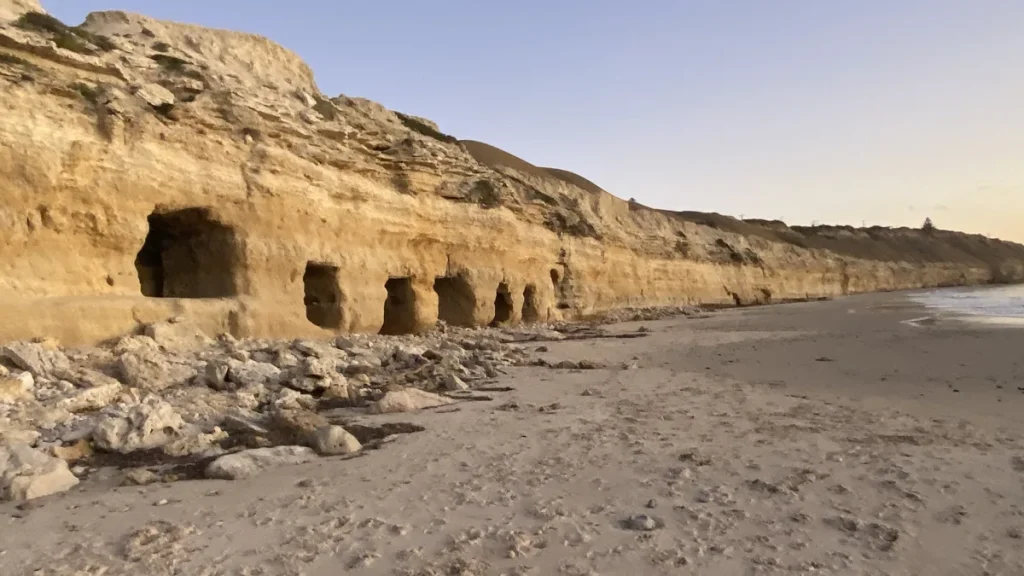
Illustrative: the beach at Port Willunga on the Fleurieu Peninsula, South Australia, photographed in August 2020. The photograph does not show the algal bloom or any scene described in the article.