Almost all of the world’s shallow-water coral reef ecosystems face an extremely high risk of collapse by 2075, according to the first global assessment of coral reefs under the IUCN Red List of Ecosystems, which classes 96% of them as Critically Endangered.
The IUCN, an international conservation union that advises the UN, released the assessment on Thursday 22 October from Gland, Switzerland, and Yerevan, Armenia. The Great Barrier Reef is among the reefs it lists as Critically Endangered, alongside the Coral Triangle, the Mesoamerican Barrier Reef System and the reefs of the Red Sea.
The analysis covers 127 tropical and subtropical ecoregions and 188,362 km2 of coral reefs, the IUCN said. More than 250 experts took part, covering reefs in more than 80 countries and territories, and the work was coordinated by the IUCN, its Commission on Ecosystem Management, the University of Melbourne and CORDIO East Africa. DW reported that the IUCN presented the study at COP17, the UN’s biodiversity summit in Yerevan.
Dr Grethel Aguilar, the IUCN’s Director General, said in the release: “It is not too late to give coral reefs a chance to recover, but it requires decisive action to tackle climate change and halt further ocean warming.”
All 17 Australian Regions
The Guardian reported that four of Australia’s 17 reef regions were already Critically Endangered, five were Endangered and five were Vulnerable. Once expected climate impacts were included, all 17 became Critically Endangered, the Great Barrier Reef among them. The categories run in order of rising risk, from Vulnerable through Endangered to Critically Endangered, with Collapsed at the end of the scale.
The Australian assessment was led by Dr Ben Fitzpatrick of the University of Western Australia Oceans Institute, according to the Guardian. “Reefs are like Picasso paintings under water,” he said, the Guardian reported. He also said: “There’s one message. We have to stop burning fossil fuels.”
The Guardian reported that the assessment did not fully account for the fourth global mass bleaching event, which ran from early 2023 to mid-2025.
What Collapse Means
In the IUCN’s terms, a reef collapses when hard corals almost disappear and algae, rubble and sponges take over. Shallow-water reefs are found at depths of up to around 40 metres, DW reported.
The assessment used the IPCC’s “middle-of-the-road” scenario, which projects 2.7°C of atmospheric warming by the end of the century. Climate is not the only pressure on reefs, though: the IUCN said overexploitation of key fish groups such as parrotfish and grouper threatens 63% of coral reef ecosystems.
Four of the 127 ecoregions are listed as Data Deficient. The Western Galápagos Islands ecoregion has been classed as Collapsed since the 1982-83 El Niño. A separate IUCN reassessment of 892 reef-building coral species found 44% of them threatened with extinction.
A Window That Is Narrowing
How much of the outlook rests on future warming shows in a second figure. Based only on observed change over the past 50 years, without climate projections, 24% of reef ecosystems would be Critically Endangered rather than 96%, the IUCN said.
Dr Mishal Gudka, the assessment’s scientific lead and CORDIO East Africa’s Research Director, said in the IUCN release: “The risk of coral reef collapse is escalating, but this must be a wake-up call rather than a cause for despair.”
“The actions we take over the next few years will determine what these ecosystems look like at the end of the century, whether they persist as we have known them, or whether they transform into a different ecosystem, which is worth less to both nature and people,” Dr Gudka said, DW reported.
Our earlier reporting on Australian waters includes the toxic algae bloom that killed more than 200 marine species off South Australia. More is in our Environment section.
Sources: IUCN, “Virtually all coral reef ecosystems face high risk of collapse in 50 years: IUCN Red List of Ecosystems”, 22 October 2026 (https://iucn.org/press-release/202610/virtually-all-coral-reef-ecosystems-face-high-risk-collapse-50-years-iucn-red); The Guardian, “Almost every shallow-water coral reef on the planet faces ecosystem collapse by 2075, UN advisors say”, 22 October 2026 (https://www.theguardian.com/australia-news/2026/oct/22/shallow-water-coral-reef-ecosystem-collapse-by-2075-un-advisors-say); DW, “96% of world’s coral reefs face critical risk of collapse”, 22 October 2026 (https://www.dw.com/en/96-of-world-s-coral-reefs-face-critical-risk-of-collapse-iucn-warns/a-79736234)
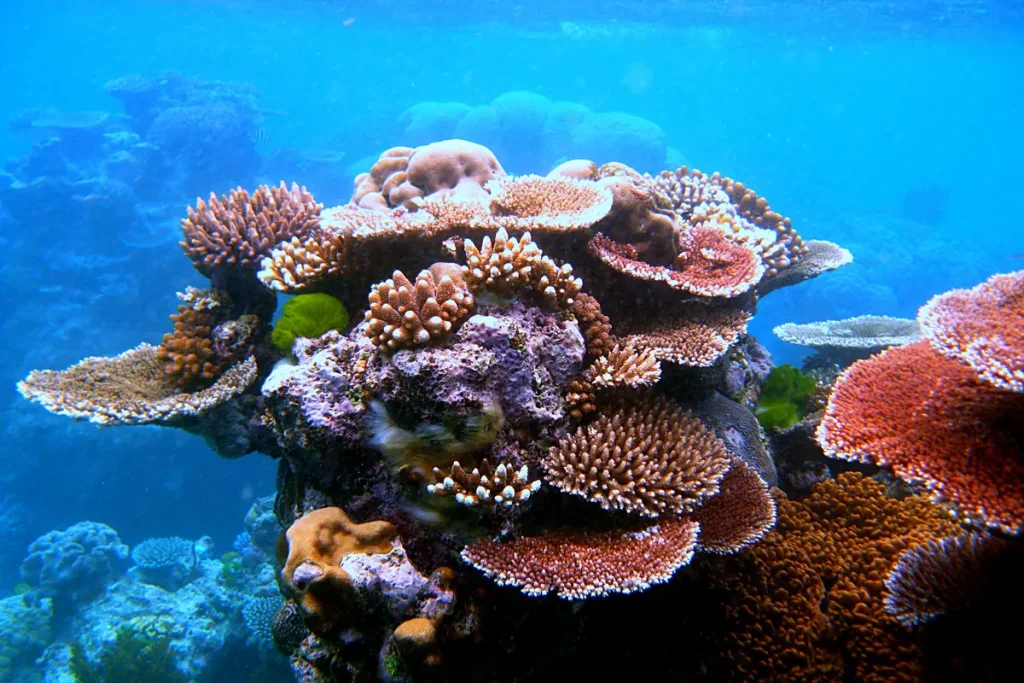
Photo: Toby Hudson, CC BY-SA 3.0, via Wikimedia Commons.
Corals growing on Flynn Reef, part of the Great Barrier Reef off Cairns, photographed in July 2010.