An estimated 42,500 koalas live in blue gum plantations in south west Victoria, and between 8,000 and 10,000 hectares of plantation are harvested each year, displacing thousands of the animals into land that cannot sustain them. The Guardian reported the situation on 11 May 2025.
The Displacement
The plantations were established in the 1990s and 2000s and became accidental, high density koala habitat. Victorian government data puts the number of koalas living in them at about 42,500. When the blue gums are cut, the animals move into road reserves, neighbouring paddocks and nearby native forests, stripping them of food and cover. Some move into adjacent plantations and are displaced again the next year. The annual harvest area of between 8,000 and 10,000 hectares is recorded in the state’s koala strategy. The plantations are privately owned.
What the Scientists Say
Dr Desley Whisson, a senior lecturer at Deakin University, said thousands of koalas were likely displaced each year, based on population density and the scale of logging. “It’s a pretty stressful situation for koalas. The blue gum plantations get cut down, and those koalas have to find somewhere to go,” she said. She called it a wicked problem that was likely to get worse, while saying landscape scale solutions exist.
Dr Kita Ashman of WWF Australia said the plantations attracted koalas in large numbers. “We’re basically planting up this smorgasbord of plantations that koalas then move into, feed on, breed in,” she said. She said the industry must obtain permits, engage koala spotters and retain a minimum of nine trees around any animal seen during harvesting, but that there was little onus on it to consider what happened to displaced animals. She said the answer should not be to remove the plantations, which are an alternative to native forest logging.
Dr Rolf Schlagloth of Central Queensland University said: “The real issue is the lack of connectivity [of nature] and failing to properly manage koala habitat.” He described the problem as solvable, and said: “We need open, honest discussion… to make sure that our koalas, which are a flagship species, are saved.”
The Toll
A licensed koala shelter operator in the south west, who asked not to be named, told The Guardian she helped up to 450 sick or injured animals a year. Some were still in trees when they were felled and suffered broken bones, she said. Others were orphaned joeys left behind, or were attacked by cows or dogs. Some koalas froze in the lights of logging trucks. “The amount of road kill is just horrendous. They’ve been in a huge, big forest all their life. And then all of a sudden it’s ripped down around them,” she said.
A 2023 University of Queensland study of reported wild koala deaths in south east Queensland found vehicles were responsible for about half of all fatalities, 1,431. CSIRO estimates the national koala population at between 224,000 and 524,000. Koalas are listed as endangered in New South Wales, Queensland and the Australian Capital Territory, but in south west Victoria and South Australia there are not enough trees to sustain the populations.
The Government’s Position
Victoria’s koala strategy, released in May 2023, acknowledges the welfare risks of plantation harvesting. “There are currently no cost-effective management techniques available that would be acceptable to the community, or clear objectives for the management of koalas in blue gum plantations,” it states. The state environment department told The Guardian it was working with animal welfare groups and experts and had invested $3.3 million in koala management and research. A spokesperson said: “Victoria is fortunate to have a large koala population, but it does face threats such as disease, climate change and poor genetic diversity in some of the populations.”
What Could Change
Dr Whisson said options included leaving a portion of each plantation for koalas, having the industry contribute to restoring permanent habitat, and supporting wildlife carers and animal hospitals. She said planting an alternative tree species that koalas find less palatable was a longer term option. The scientists said the problem was manageable but unmanaged, and that action was needed at a landscape scale.
Related: Toxic Algae Bloom Kills More Than 200 Marine Species off South Australia
Sources: The Guardian, https://www.theguardian.com/environment/2025/may/11/koalas-face-death-attacks-and-starvation-as-blue-gums-chopped-down-in-victoria; The Guardian, https://www.theguardian.com/australia-news/2025/apr/12/koala-habitat-destroyed-since-2011-analysis; Victorian Government (Conservation Regulator), https://www.vic.gov.au/koalas-blue-gum-plantations
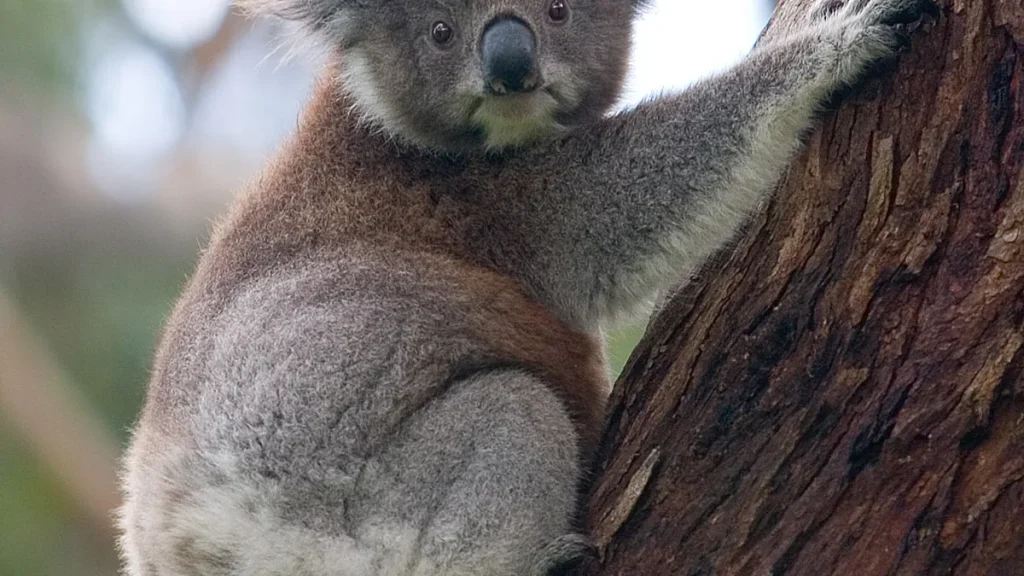
Photo: Diliff, CC BY-SA 3.0, via Wikimedia Commons.
Illustrative: a koala climbing a tree in the Great Otway National Park, Victoria, photographed in 2004. The photograph does not show any animal or location described in the article.