
Alphabet shares fell nearly 13% on Thursday 29 October, US time, their worst day since Google went public in 2004, wiping roughly US$500 billion off the company’s value, CNBC reported.
The BBC put the loss at just over US$500bn. It said Alphabet’s market value fell to US$3.46 trillion, from US$3.97 trillion at the previous close, a six-month low.
The fall followed quarterly results released late on Wednesday 28 October, US time. It was the first time in nearly four years that the company had missed expectations on both revenue and earnings, according to CNBC.
What the Results Showed
Revenue rose 25% to US$127.6 billion, the BBC reported, but profit fell. Net income was US$26.17 billion, or US$2.12 a share, down from US$34.98 billion, or US$2.87 a share, a year earlier, CNBC reported, and operating income of US$40.58 billion fell short of a US$43.19 billion FactSet forecast.
Search advertising grew 12% to US$63.35 billion, short of an estimate of US$64.96 billion, according to CNBC. It was the second straight quarter in which search missed, with growth slowing from 19% in the first quarter and 17% in the second, even as Google reported its strongest query growth in five years.
Executives said foreign exchange was the biggest factor in the slowdown, and that the currency impact would be greater in the fourth quarter. Chief business officer Philipp Schindler also said lower monetisation in AI Mode was partly to blame. “We continue to accelerate the deployment of Gemini models across our entire ads infrastructure to boost performance,” he said on the call.
Free cash flow was negative US$9.07 billion, against expectations of about US$2.7 billion, CNBC reported. It first went negative in the second quarter, at US$5.9 billion, and the BBC said this was only the second negative quarter in Alphabet’s history as a public company. Finance chief Anat Ashkenazi explained the outflow on the call. “You see cash going out and we’re building up the inventory base,” she said. “As we start delivering and billing customers for these TPU systems, then you see cash coming in.”
Cloud revenue more than doubled, up 103% to US$30.7 billion, and the cloud backlog reached roughly US$560 billion, CNBC reported. Management expects just over half of that to be recognised within 24 months. The Gemini app has reached 1 billion users.
The Cost of AI
Capital spending was US$51.36 billion in the quarter, CNBC reported, and Alphabet held its full-year guidance at US$195 billion to US$205 billion.
“We continue to expect our capex to increase significantly in 2027, and will provide further details on our Q4 call,” Ms Ashkenazi said on the earnings call, according to CNBC.
Alphabet’s balance sheet has also shifted. Long-term debt rose to US$125.1 billion, from US$21.6 billion a year earlier. Alphabet’s equity holdings, which include stakes in SpaceX and Anthropic, produced a loss of US$8.66 billion in the quarter, CNBC reported.
The build-out behind AI has its own politics in Australia, including Anthony Albanese’s move to block data centres near homes and farms.
Why Investors Flinched
Tracy Woo of Forrester told the BBC that Alphabet’s search results “highlights the challenge of funding massive AI investments while maintaining the strength of established businesses.”
UBS wrote that the results are “going to bring Search cannibalization fears right back to the forefront.” Gil Luria of D.A. Davidson went further in an email to CNBC: “Investors will now worry that the miss in Search, YouTube and Subscription, leading to a profit miss, are an indication that AI has finally come for Google,” he wrote.
Others looked at how the results were presented. Ben Barringer of Quilter Cheviot told CNBC that Alphabet “saw its share price hit after hours as a result of a fairly messy set of results and a poorly handled earnings call”.
Not everyone read the fall as a turning point. “I don’t think it’s a sea change,” Scott Devitt of Rosenblatt Securities said on CNBC’s “Squawk on the Street”. Brent Thill of Jefferies, on CNBC’s Closing Bell: Overtime, pointed to cloud: “The cloud business was the only business that beat at 103% growth,” he said.
Alphabet was not the only large technology company to fall after its results. Amazon shares dropped 6% in after-hours trading following its own figures, the BBC reported.
More technology news is in our Technology section.
Sources: BBC News, “Google value plunges by $500bn as AI fears rattle Wall Street”, 30 October 2026 (https://www.bbc.co.uk/news/articles/cm9qzdqpxy48o); CNBC, “Alphabet tanks nearly 13% for worst day ever, losing $500 billion in value”, 29 October 2026 (https://www.cnbc.com/2026/10/29/alphabet-google-microsoft-msft-shares-today-earnings.html); CNBC, “Alphabet sinks 10% as it holds 2026 capex unchanged, expects significant increase in 2027”, 28 October 2026 (https://www.cnbc.com/2026/10/28/alphabet-googl-earnings-q3-2026.html); CNBC, “Alphabet earnings miss reflects first real sign that AI is taking a bite out of search”, 29 October 2026 (https://www.cnbc.com/2026/10/29/alphabet-google-search-ai-earnings.html)
Photo: Asoundd, CC BY-SA 4.0, via Wikimedia Commons.
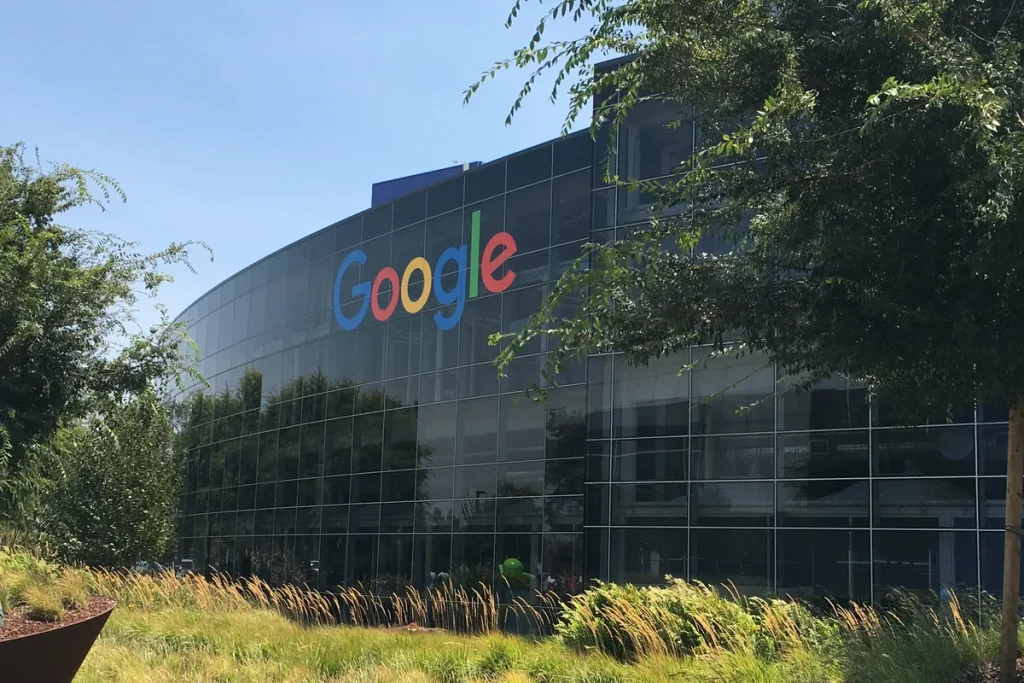
A Google office building at the company’s Mountain View campus in California, in July 2016.