Researchers at Mass General Brigham in Boston have developed FaceAge, a deep learning tool that estimates a person’s biological age from a single face photograph, including a selfie, according to results published in The Lancet Digital Health and reported by the Guardian on 13 May 2025.
The Study
FaceAge was trained on 58,851 photos of presumed healthy individuals drawn from public datasets, according to the Mass General Brigham news release. Clinical validation used 6,196 cancer patients from two centres, in the Netherlands and the United States, whose photos were taken at the start of radiotherapy. Their results were compared with a reference group of 535 patients without cancer.
The tool estimates biological rather than chronological age, meaning how old a person appears to be physiologically. The Guardian illustrated the distinction with estimates the coverage used: at the age of 50, the actor Paul Rudd’s estimated biological age was 43, while Wilford Brimley’s was 69.
What It Found
Patients with cancer appeared about five years older than their chronological age, the researchers reported. Older FaceAge estimates were associated with worse overall survival across cancer types after adjusting for age, sex and cancer type, and the association was strongest in those who appeared older than 85. The findings describe statistical associations in the study cohort and not forecasts for any individual.
In a sub-study, ten clinicians predicted short-term life expectancy from 100 photos of palliative radiotherapy patients and did only slightly better than a coin flip, according to Mass General Brigham. Their performance improved significantly when they were given the patient’s FaceAge alongside the photo.
What the Researchers Say
Hugo Aerts, director of the Artificial Intelligence in Medicine program at Mass General Brigham, said the work shows clinical promise. “We can use artificial intelligence (AI) to estimate a person’s biological age from face pictures, and our study shows that information can be clinically meaningful,” he said. “How old someone looks compared to their chronological age really matters, individuals with FaceAges that are younger than their chronological ages do significantly better after cancer therapy.”
Ray Mak, a radiation oncologist and co-senior author of the study, said the approach could open new lines of research. “This opens the door to a whole new realm of biomarker discovery from photographs, and its potential goes far beyond cancer care or predicting age,” he said. “As we increasingly think of different chronic diseases as diseases of aging, it becomes even more important to be able to accurately predict an individual’s aging trajectory.”
The Limits
The tool is not ready for clinical use. The researchers say further research is needed before it could be considered for real-world settings. The model was primarily trained on white faces and it is unclear how well it adapts to other skin tones, a point the Guardian reported. How it handles plastic surgery, makeup, lighting and face angle is also untested.
Biometric Update, in its coverage of the study, described the tool as a potentially powerful diagnostic advance that carries what it called big ethical baggage, and warned that claims of objectivity in tools of this kind carry risks.
Related: Tech-Savvy and Still Sharp: Study Links Technology Use to Lower Dementia Risk
Sources: Mass General Brigham, https://www.massgeneralbrigham.org/en/about/newsroom/press-releases/ai-face-photos-tool-estimate-age-predict-cancer-outcomes; The Guardian, https://www.theguardian.com/technology/2025/may/13/faceage-the-ai-tool-that-can-tell-your-biological-age-through-one-photo; Biometric Update, https://www.biometricupdate.com/202505/faceage-biometric-tool-assesses-how-old-you-look-considers-your-chances-of-survival
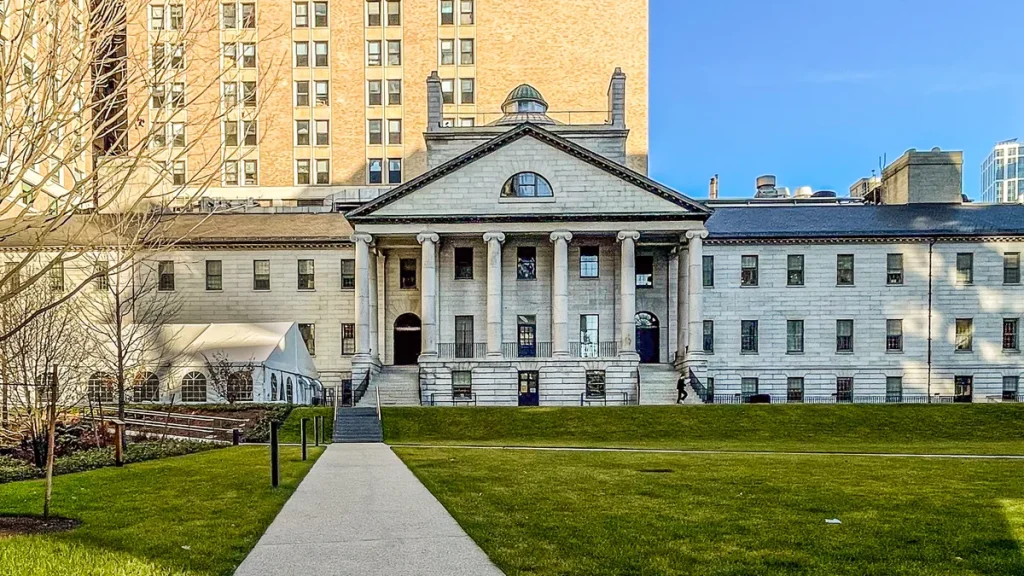
Photo: Kenneth C. Zirkel, CC BY 4.0, via Wikimedia Commons.
Illustrative: the Bulfinch Building at Massachusetts General Hospital in Boston. Mass General Brigham, the health system behind the FaceAge research described in the article, is based in Boston; the photograph is not connected to the study.