The US Treasury sanctioned the Comanchero Outlaw Motorcycle Gang, four of its senior members and an associate on Thursday 19 November 2026, US time, according to a Treasury release. Treasury’s Office of Foreign Assets Control (OFAC) said it had “sanctioned two international drug trafficking organizations”, the Australia-headquartered Comanchero gang and the Italy-based ‘Ndrangheta.
These are designations that rest on allegations in a Treasury release, which the Australian Federal Police (AFP), AUSTRAC and New Zealand Police back. They are not findings of guilt, and the Treasury, AFP and New Zealand Police releases report no charge against any of the five as a result.
The AFP and AUSTRAC said in a joint release dated 20 November: “It is the first time OFAC sanctions have applied to an Australian-based organised crime group.”
Who Treasury Designated
Treasury’s release describes the five people by role. A Spain-based “World Commander” and an Australia-based “World President” were designated as leaders or officials of the gang. A national president of the gang’s New Zealand chapter and his brother, a senior member, were designated for acting on its behalf. The fifth, an associate, was designated for providing support, and Treasury alleges the associate supplied encrypted communication platforms to drug traffickers and shielded them from police phone taps. The AFP’s own phrase for the group is “four senior members and a key associate”.
What Treasury Alleges
Treasury alleges that the gang has “strategic partnerships” with US-sanctioned cartels including the Sinaloa Cartel, CJNG, Clan del Golfo and Los Choneros, and that it “facilitated multi-hundred-kilogram shipments of cocaine from South America to the United States, Australia, and Europe”. It also alleges the gang has been “involved in other criminal activity around the world, including assassinations, arms trafficking, and money laundering”.
“Cartels do not operate in isolation. They rely on other criminal organizations like the Comancheros and ‘Ndrangheta to move drugs, launder illicit proceeds, and ultimately poison Americans with narcotics,” said Treasury Secretary Scott Bessent in the release.
The gang started in Australia in the 1960s and has chapters worldwide, the AFP said. Treasury said OFAC worked with the AFP, New Zealand Police, Italy’s Guardia di Finanza and Canadian police.
What New Zealand Police Said
New Zealand Police said in a release, reported by 1News, that 119 Comanchero members and nominees have been identified in New Zealand, of whom 59 are in custody and 41 are under supervision or release conditions. The first New Zealand chapter formed in 2018, and the police describe “six years’ worth of investigative work”. Other members “are not automatically sanctioned solely because of membership” but are “at significant risk of becoming designated”, the police explainer says.
What the Designations Do, and What They Do Not
Treasury says all property and interests of the designated people “that are in the United States or in the possession or control of U.S. persons” are blocked and must be reported to OFAC. Entities owned 50 per cent or more by blocked people are also blocked, US persons are generally prohibited from transactions involving them, and foreign financial institutions that knowingly conduct significant transactions for a designated person risk secondary sanctions. Treasury says: “The ultimate goal of sanctions is not to punish, but to bring about a positive change in behavior.”
Australia’s own reach is indirect. The AFP and AUSTRAC release says “Australia does not enforce US sanctions”, but that Australian banks access the US financial system and “will be cautious about providing services or processing transactions for someone sanctioned by the US”. It says sanctioned people “may face” closure or restriction of their Australian bank accounts and difficulty getting home loans, which are the AFP’s expectations, not reported outcomes. Stephen Nutt, the AFP’s Assistant Commissioner Global Operations, said in the release: “Our objective is to make it harder, riskier and more expensive for the Comanchero to operate.”
The sources differ on how far the block reaches. New Zealand Police Detective Superintendent Greg Williams said the group’s accounts and assets “are blocked”, but Treasury’s own wording limits the block to property in the United States or controlled by US persons. New Zealand Police’s explainer says banks around the world “can refuse” to deal with them.
As at the morning of Friday 20 November, the position is limited. Treasury has designated a gang and five people on allegations in its own release, and the AFP, AUSTRAC and New Zealand Police back the action. No one has been convicted by it. Its direct force falls on US persons and on access to the US financial system, and any wider effect on Australian banks is, so far, the AFP’s expectation rather than a reported result.
More from our Crime & Courts section, and earlier on US sanctions pressure: the International Criminal Court winning the EU’s Sakharov Prize as US sanctions bite.
Sources: US Department of the Treasury, “Treasury Sanctions Major Drug Trafficking Organizations Supporting Terrorist Cartels”, press release, 19 November 2026 (https://home.treasury.gov/news/press-releases/sb0696); US Treasury Office of Foreign Assets Control, Recent Actions, 19 November 2026 (https://ofac.treasury.gov/recent-actions/20261119); Australian Federal Police and AUSTRAC, “Comanchero OMCG targeted by US financial sanctions”, joint media release, 20 November 2026 (https://www.afp.gov.au/news-centre/media-release/comanchero-omcg-targeted-us-financial-sanctions); New Zealand Police, “NZ Police welcome sanctions announcement on Comancheros”, media release (https://www.police.govt.nz/news/release/nz-police-welcome-sanctions-announcement-comancheros); The Sydney Morning Herald, “US hits Comanchero outlaw motorcycle gang with sweeping sanctions”, 20 November 2026 (https://www.smh.com.au/national/us-hits-comanchero-outlaw-motorcycle-gang-with-sweeping-sanctions-20261120-p61fqf.html); 1News, “Comancheros leaders in NZ among those targeted by sweeping US sanctions”, 20 November 2026 (https://www.1news.co.nz/2026/11/20/comancheros-leaders-in-nz-among-those-targeted-by-sweeping-us-sanctions/)
Photo: Wisneyykarin, CC BY-SA 4.0, via Wikimedia Commons.
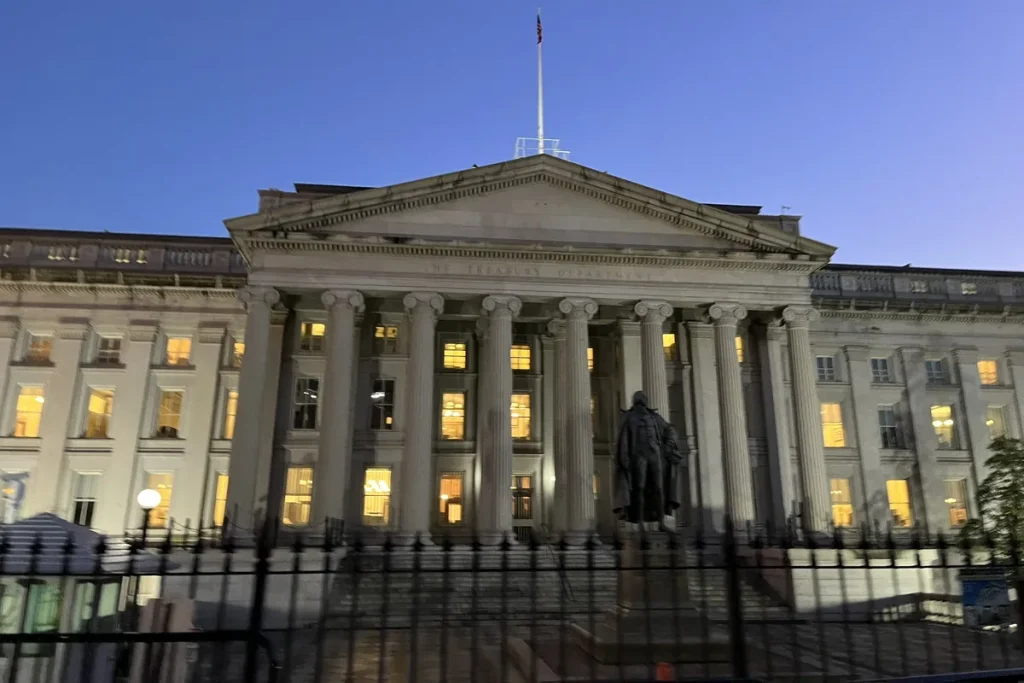
The US Treasury Department building in Washington at dusk, photographed in February 2023. A file image of the department that announced the sanctions; it shows nothing connected to the case.