The International Court of Justice found Myanmar responsible for genocide against the Rohingya on Thursday 19 November 2026, ruling by nine votes to six, the BBC reported. The Guardian described the majority as nine judges on the 15-seat court. The Gambia brought the case in 2019, Radio Free Asia reported, and the decision was read at The Hague over more than two hours, according to the Guardian.
It is a finding of state responsibility under the 1948 Genocide Convention, not a criminal conviction. No individual was tried or sentenced, the BBC and ABC News both reported, and ABC reported that the judgment is final and cannot be appealed.
What the Court Found
Court President Iwasawa read the finding, ABC reported: “the Republic of the Union of Myanmar has committed genocide against the Rohingya group in Northern Rakhine State”. It is the first time the ICJ has found a state responsible for genocide, according to the Guardian, BBC, Radio Free Asia and ABC.
On intent, the BBC reported the Court said “genocidal intent is the only reasonable inference that can be drawn from the evidence”. Radio Free Asia reported that the Court also found Myanmar failed to prevent genocide, and the BBC reported that the majority found violations of several other parts of the Convention.
On what happened, ABC reported the Court found that Myanmar’s security forces killed thousands of Rohingya civilians, carried out widespread sexual violence and attacked people as they fled. The BBC reported that the Court put the number of Rohingya “violently killed” in the clearance operation at around 10,000, and that more than 700,000 are thought to have fled to Bangladesh.
How Myanmar’s Defence Fared
Myanmar argued that its 2016-17 operations were counter-terrorism against the Arakan Rohingya Salvation Army, the BBC, ABC and Guardian reported. The Guardian reported that the judges rejected that as the primary purpose and also rejected an argument that the operations amounted to punishment or forced displacement without genocide. The BBC reported that the Court recognised the group’s role but found an “overlap” between an “anti-Rohingya hate speech campaign” and the clearance operations.
The Guardian also reported that the ruling formally classified the Rohingya as a distinct ethnic group under international law, which Myanmar has denied; it calls them Bengalis or foreign migrants. Government representative Ko Ko Hlaing said he had “no comment” after the verdict, the BBC reported.
Reactions on 19 November
Yousuf Ali, a survivor who travelled to the court, said: “Today, we have finally been heard, and it is a profound relief,” the Guardian reported.
Volker Türk, the UN human rights chief, said the “suffering, misery and humiliation” inflicted on the Rohingya was a “stain on the conscience of humanity”, and the decision “must now translate into real action”, the BBC reported.
UK foreign secretary Ed Miliband said on 19 November that the UK government was expelling Myanmar’s defence attache and called “urgently” for a UN Security Council session, the Guardian and the BBC reported.
What the Court Ordered, and What It Cannot Enforce
Myanmar must pay reparations, with the amount to be decided later, the BBC and ABC reported. ABC quoted the Court calling for a “safe and dignified return to their place of residence and the reunification of families for the Rohingya displaced as a result of Myanmar’s wrongful acts”.
The ICJ cannot send anyone to prison and relies on the UN Security Council and political pressure, the BBC reported, and ABC reported that the matter can go to the Security Council if Myanmar does not comply. “One of the features of the international legal system is that we don’t have much in the way of enforcement of judicial decisions,” said William Schabas, a professor of international law at Middlesex University, in comments carried by ABC.
Richard Horsey of the International Crisis Group said in a statement carried by Radio Free Asia: “The court has no means of enforcing this ruling. What matters now is whether the governments engaging Naypyitaw are prepared to attach any cost to ignoring it.”
The judgment settles the legal question. The Court found a state responsible, not an individual, and the finding is final. What it changes beyond The Hague depends on the Security Council and on the choices of governments, the point both Schabas and Horsey make.
More world coverage is in our International section, including the earlier report on the International Criminal Court winning the EU’s Sakharov Prize as US sanctions bite.
Sources: The Guardian, “Myanmar committed genocide against Rohingya minority, world’s top court rules”, 19 November 2026 (https://www.theguardian.com/world/2026/nov/19/genocide-rohingya-international-court-of-justice-ruling-myanmar); BBC News, “Myanmar committed genocide against Rohingya minority, top UN court rules”, 19 November 2026 (https://www.bbc.co.uk/news/articles/c804wzp20ddvo); ABC News, “Myanmar committed genocide in Rohingya massacres, UN court finds in historic verdict”, 19 November 2026 (https://www.abc.net.au/news/2026-11-19/myanmar-historic-genocide-verdict-at-un-court/107403108); Radio Free Asia, “World Court finds Myanmar responsible for Rohingya genocide in landmark ruling”, 19 November 2026 (https://www.rfa.org/english/myanmar/2026/11/19/rohingya-genocide-icj-ruling-myanmar/); International Court of Justice, The Gambia v. Myanmar, judgments and press releases, 19 November 2026 (https://www.icj-cij.org/case/178/judgments)
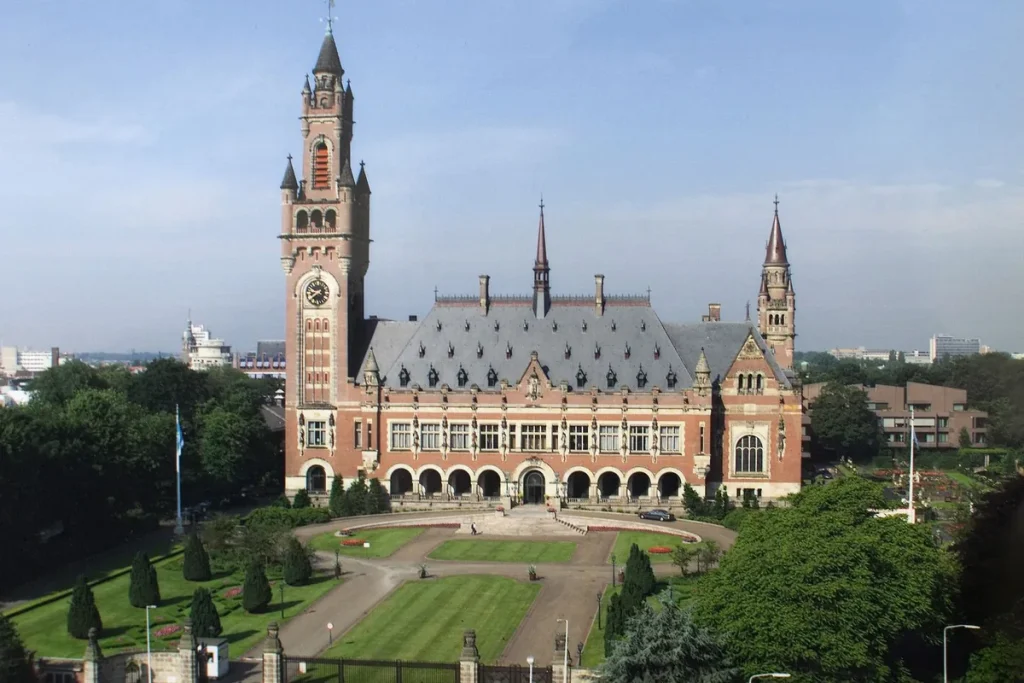
Photo: International Court of Justice, public domain, via Wikimedia Commons.
The Peace Palace in The Hague, where the International Court of Justice sits, photographed in 2006 and released by the Court into the public domain. Shown for illustration only.