Rio Tinto will put US$250 million “over the coming years” into a fund to respond to the damage identified at the former Panguna copper and gold mine on Bougainville, under an agreement announced on 16 November 2026 with Bougainville Copper Limited (BCL) and the Autonomous Bougainville Government (ABG).
The three parties agreed with community leaders to set up the fund, according to Rio Tinto’s release of 16 November, which describes the money as a voluntary contribution and puts it at “approximately PGK 1.1 billion based on current exchange rates”. The Guardian, reporting the agreement on 17 November, gave the figure as A$370m.
What the Money Is Meant to Cover
Rio said the fund will respond to impacts identified by the Panguna Mine Legacy Impact Assessment (PMLIA), through practical responses in the river and delta areas and social programs across the mine, port and town areas. Its priorities and scope are to be set in consultation with communities and aligned with the UN Guiding Principles on Business and Human Rights, the company said.
Mark Davies, Rio Tinto’s chief safety and technical officer, said: “Rio Tinto’s contribution towards addressing findings of the Panguna Mine Legacy Impact Assessment (PMLIA) is intended to support the transition from the assessment to practical remedy implementation.”
Theonila Roka-Matbob, the lead complainant, said in the release: “Seven years ago, Panguna communities came together to call for action to address the devastation left by the Panguna mine. Today marks a very important step on that journey.”
She added: “We have a lot of work still ahead of us, but the establishment of this fund gives us the chance to find solutions to the huge problems we have been living with since the days of the mine’s operation. All of us must now work together with urgency to turn this commitment into real, lasting improvements in the lives of our people.”
Ishmael Toroama, the President of Bougainville, said: “This fund represents an important step forward and an opportunity to deliver lasting benefits for communities. Through practical improvements to local infrastructure and support for livelihoods, we are on the path to making a meaningful difference to villages and communities.”
Keren Adams, legal director of the Human Rights Law Centre, said in the release: “The significant funding contributed by Rio Tinto creates a real opportunity to now address an environmental disaster that has remained unresolved for decades.”
How the Assessment Came About
The PMLIA began after a complaint by local communities, who were represented by the Human Rights Law Centre, Rio said. An oversight committee was set up in 2021, a Roundtable of the ABG, BCL and Rio was formed in 2024, and the independent assessment was published in December 2024.
The National Indigenous Times reported that the assessment was carried out by Tetra Tech Coffey and found parts of the pit, levee, roads and old buildings at extreme risk of collapse. It also found violations at some sites of Indigenous peoples’ rights to water, education and culture, according to NIT. Roka-Matbob received a 2026 Goldman Environmental Prize in April, the outlet reported.
The Mine and the War
The mine operated from 1972 to 1989, and more than a billion tonnes of waste went into the Jaba and Kawerong rivers, NIT reported. It closed in 1989 after a sabotage campaign led by a former mine worker, Francis Ona, the Guardian reported, and Bougainville’s civil war ran for a decade, with as many as 20,000 people killed.
The Guardian reported that Rio and other investors earned nearly US$2bn from the mine over 17 years, while less than 1% of profits went to Bougainvilleans. Rio held 53.8% of BCL until it divested in 2016, according to the company’s release.
What the Fund Does Not Decide
The fund is separate from any decision on redeveloping the mine or the port. Those decisions “sit with the ABG and the people of Bougainville”, Rio said. The fund’s own structure, governance and delivery are still to be developed with communities, the ABG, BCL and Rio.
ABG chief secretary Kearnneth Nanei said the government was committed to the remedial programs while managing redevelopment activity by Bougainville Minerals Ltd, according to Rio’s release. The Guardian reported that an Indian miner, Lloyds, holds a 25-year large-scale mining lease, though any future mining is years away.
The Guardian also said the amount will not be enough to fully remediate the site. Roka-Matbob, speaking to the Guardian, said: “No amount of money will restore the damage caused to the environment in Panguna, but this sets a foundation for us to invest in addressing the environmental issues and invest in our children’s futures as well.”
There is more in our International section and our Environment section.
Sources: Rio Tinto, “Rio Tinto, BCL and ABG to establish fund to support Panguna mine legacy impact response”, 16 November 2026 (https://www.riotinto.com/en/news/releases/2026/rio-tinto-bcl-and-abg-to-establish-fund-to-support-panguna-mine-legacy-impact-response); The Guardian, “Rio Tinto agrees to pay US$250m to begin repairing ‘devastation’ left by Panguna mine”, 17 November 2026 (https://www.theguardian.com/world/2026/nov/17/rio-tinto-250m-panguna-mine-clean-up-bougainville-png); National Indigenous Times, “US$250 million commitment marks new chapter in addressing Panguna mine legacy”, 17 November 2026 (https://nit.com.au/17-11-2026/27568/us250-million-commitment-marks-new-chapter-in-addressing-panguna-mine-legacy)
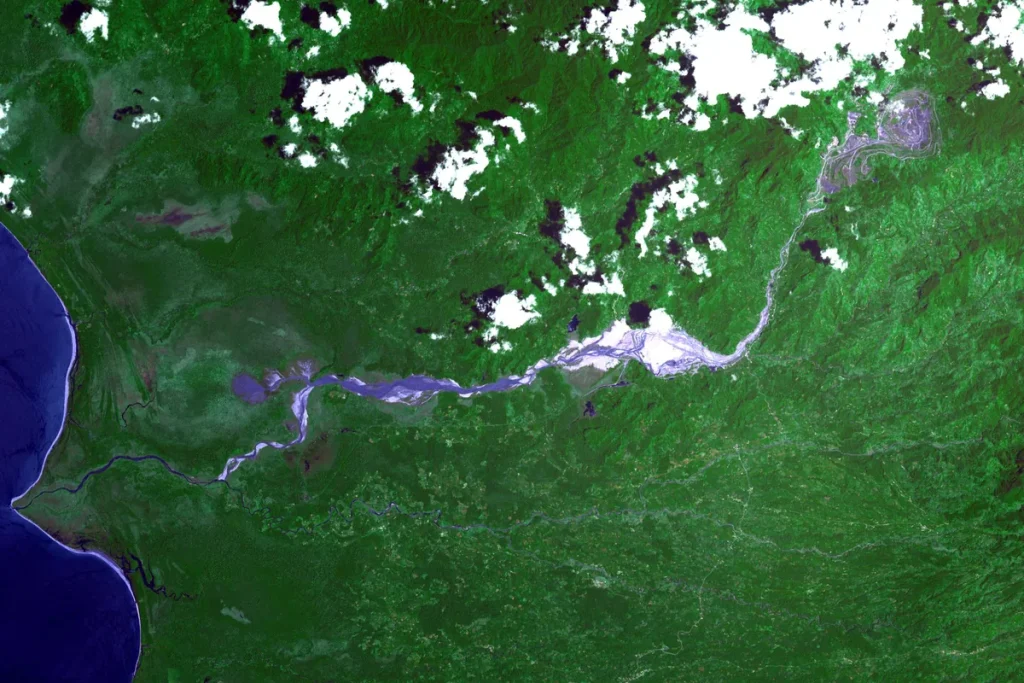
Image: NASA/METI/AIST/Japan Space Systems and U.S./Japan ASTER Science Team, public domain, via Wikimedia Commons.
Satellite view of the former Panguna pit (upper right) and the pale river valley running from it to Bougainville’s west coast, recorded by the ASTER instrument on 12 November 2013.