Iran executed Hassan Divband, Hamid Kazemi and Reza Zanganeh on Sunday 8 November after the Supreme Court upheld their death sentences, The Jerusalem Post and Iran International reported. Rudaw reported that the three men were hanged in Karaj, in Alborz province.
Two other protesters, Amirhossein Maleki and Amirhossein Ebrahimi, had been executed on the Tuesday before the 8 November hangings, Rudaw reported, making five in less than a week.
What the Judiciary Alleged
According to the judiciary, the three men carried out armed attacks, arson and damage to public infrastructure in Karaj on 8 and 9 January, including at an electricity substation, and conducted operations for Israel, the United States and “hostile groups”, The Jerusalem Post and Iran International reported. Their sentences also included the confiscation of their property.
The BBC, citing the state news agency Tasnim, reported that the court found them guilty of “participating in operational activities on behalf of the Israeli Zionist regime, the United States and hostile groups”. Tasnim also reported, according to The Jerusalem Post, that investigators claimed to have recovered two hunting rifles, ammunition, and evidence of 20 Molotov cocktails and 15 homemade explosive devices.
The judiciary said confessions, surveillance footage and intelligence reports supported the convictions, though The Jerusalem Post noted that this evidence has not been independently examined. State media alleged that the men had acted on calls for protests by the exiled Crown Prince Reza Pahlavi, the paper reported.
Mr Divband was arrested on 11 January, and ten other people were arrested later, the BBC and Iran International reported. The Karaj Revolutionary Court sentenced eight other defendants to between five and 10 years in prison, according to Iran International and The Jerusalem Post.
Authorities alleged that Mr Divband, 30, owned an automotive repair business, The Jerusalem Post reported. The paper, citing the rights group Hengaw, said Mr Zanganeh, 27, an automotive technician, was arrested in April. People close to Mr Zanganeh rejected the espionage allegations, saying they arose from his work repairing imported vehicles and from earlier business travel. Two days before the executions, the rights group HRANA had reported that Mr Divband and Mr Kazemi were sentenced to death by Branch 2 of the Karaj Revolutionary Court.
How Rights Groups Have Responded
Human Rights Watch and the Abdorrahman Boroumand Center reviewed 29 protest-related executions carried out between March and August and found that 16 involved no allegation of killing, The Jerusalem Post and Iran International reported.
The two groups also said a 2025 law, which raised penalties for espionage and for cooperation with Israel and other states designated hostile, was being used against protesters, citing allegations of torture, coerced confessions and restricted access to lawyers, according to The Jerusalem Post.
“The authorities’ message is clearly that protests will be met with brutality,” Bahar Saba of Human Rights Watch said in September, the paper reported.
The protests began in December 2025 over the cost of living and peaked on 8 and 9 January 2026, the BBC reported. Authorities reported more than 3,000 deaths and blamed “terrorist acts” by the United States and Israel.
The Count Rights Groups Are Keeping
Iran Human Rights, a group based in Norway, documented at least 691 executions in the first 10 months of 2026, including 77 in October, according to a report published on 3 November and cited by The Jerusalem Post.
An Iran International investigation counted at least 70 executions in political and security cases between 7 January and 5 October, 35 of them linked to the January protests. In October, according to Rudaw, Hengaw reported that at least 106 protesters linked to the January unrest had been sentenced to death.
The UN human rights chief, Volker Türk, said in August that at least 56 people had been executed on national security charges since 19 March, 27 of them linked to the protests, the BBC reported. Amnesty International recorded at least 2,159 executions in 2025, the most since 1981, according to the BBC.
The BBC reported that executions have increased since US-Israeli strikes on Iran began in late February, and that Iran is thought to be the world’s second most prolific executioner after China.
Our International section has more on Iran, including our March coverage of the escalating conflict and Australia’s possible role.
Sources: BBC News, “Iran executes three men for ‘armed unrest’ after January protests”, 8 November 2026 (https://www.bbc.co.uk/news/articles/ckly0ex633ydo); The Jerusalem Post, “Iran executes three men accused of working for Israel, US, taking part in anti-government protests”, 8 November 2026 (https://www.jpost.com/middle-east/iran-news/article-914168); Iran International, “Iran executes three more protesters in Karaj”, 8 November 2026 (https://www.iranintl.com/en/202611088895); Rudaw, “Iran executes three more January protesters, bringing weekly toll to five”, 8 November 2026 (https://rudaw.net/english/categories/iran/1080064)
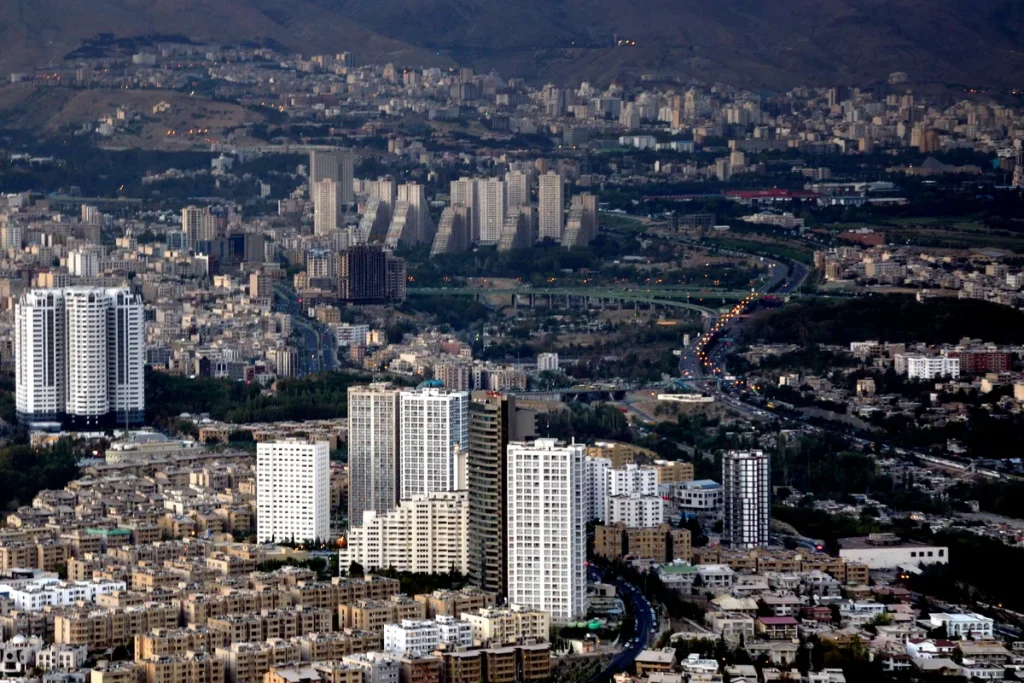
Photo: Simisa, CC BY-SA 3.0, via Wikimedia Commons.
North-western Tehran seen from the Milad Tower in September 2011. A general view of Iran’s capital, used for illustration.