The African National Congress has remained South Africa’s largest party in the 2026 municipal elections, but with just under 31% of the vote it has recorded its worst local election result, the BBC and DW reported. The party won 46% in 2021.
According to the Electoral Commission’s official declaration of results on Saturday 8 November, the ANC won 30.89% and 3,164 seats. The BBC reported that the party had won 64.82% in the local elections held 20 years earlier.
How the Rivals Fared
The commission’s declaration gave the Democratic Alliance (DA) 24.60% and 1,527 seats, the MK Party 9.61% and 701 seats, the Economic Freedom Fighters (EFF) 6.25% and 505 seats, and ActionSA 5.68% and 219 seats, with other parties and independents taking 22.97% between them.
The BBC reported that the DA’s share was up only marginally on its 21.83% in 2021 and remained below the 26.9% it won in 2016. The party kept its majority in Cape Town, the BBC and DW reported, while the MK Party unseated the ANC as the winning party in Durban.
In the municipal vote the ANC won a majority in only one of the nine provinces, Limpopo, down from six in 2021, and won the most votes in two of the eight cities, down from six, according to the BBC. The Mail & Guardian reported that the party won outright control of only 53 municipalities and led in 128.
Turnout was 52%, up 6.1 points on 45.9% in 2021, the commission said. Of 29.2 million registered voters, about 14.9 million cast a ballot for 10,526 seats across 213 councils. The commission declared the vote free and fair, though it ordered a revote in ward 3 of Siyancuma because ballots were destroyed before the count.
“It is then my singular honour to hereby declare the 2026 Municipal Elections concluded as free and fair,” commission chair Mosotho Moepya said in his declaration address.
What the ANC Is Saying
“This has been a very catastrophic outcome for the ANC,” the party’s secretary-general, Fikile Mbalula, said on Saturday 8 November, the BBC reported. Speaking to reporters, Mr Mbalula added: “We cannot ask the people to trust us merely because of our history,” according to DW.
President Cyril Ramaphosa, entering the count centre, said: “We accept the will of the people however concerning it might be”, the BBC reported. He added, as reported by the BBC: “It is a decline that is concerning, that is how I characterise it.” In his weekly presidential letter, quoted by DW, Mr Ramaphosa wrote that “municipal failures have contributed to declining public trust and confidence in democratic governance.”
“This election is delivering a devastating message to the ANC”, the analyst Susan Booysen said, as quoted by the BBC. Ms Booysen put the decline down to poor service delivery, from water and power to sanitation, and DW reported that voters blame the ANC for water and electricity shortages.
Another analyst, William Gumede, said the DA was winning more black votes, according to the BBC. “It is sort of the end of the liberation movement era in South Africa,” Mr Gumede said. “We are now in a coalition country,” he added.
The ANC lost its national majority in 2024 and now governs in a government of national unity, the BBC and DW reported. It is due to elect a new leader in 2027, while Mr Ramaphosa is due to remain president until the 2029 national elections, according to the BBC.
Fourteen Days to Build Coalitions
Parties have 14 days from the announcement of results to negotiate coalitions, the BBC reported. It said Gauteng’s three metros are under scrutiny, and that the ANC may be shut out in Johannesburg and Pretoria.
DA leader Geordin Hill-Lewis said his party was already talking to others. “We have already reached out to many parties over the last 24 hours and will continue to do so today,” he told reporters, DW reported.
According to the South African Government News Agency, 521 parties and 636 independent candidates took part, fielding about 137,000 candidates, and an Electoral Commission staff member died at a voting station in Mahikeng on election day. Before the vote, the Constitutional Court allowed the ANC to reinstate 181 councillor candidates who had missed the commission’s deadline, the Mail & Guardian reported.
The commission will now adjudicate objections lodged after the election. Its own satisfaction survey put trust in the commission at 81%, down from 93% in 2016, and spoilt votes made up 1.84% of the total.
Our International section covers other elections that have shifted power, including Serbia’s, where the student list headed for a majority.
Sources: BBC News, “South Africa’s ANC records worst-ever results in local elections”, 8 November 2026 (https://www.bbc.co.uk/news/articles/cwrkygrxp11mo); DW, “South Africa’s ANC hit by worst-ever performance in local elections”, 7 November 2026 (https://www.dw.com/en/south-africa-elections-anc-marks-its-worst-ever-performance/a-79887482); Electoral Commission of South Africa, “Chairperson Mosotho Moepya: Official Declaration of 2026 Local Government Elections Results”, 8 November 2026 (https://www.gov.za/news/speeches/chairperson-mosotho-moepya-official-declaration-2026-local-government-elections); Mail & Guardian, “ANC barely hangs on as DA and ActionSA make gains in final IEC results”, 8 November 2026 (https://mg.co.za/news/south-africa/2026-11-08-anc-barely-hangs-on-as-da-and-actionsa-make-gains-in-final-iec-results/); South African Government News Agency, “IEC declares LGE 2026 Free and Fair”, 8 November 2026 (https://www.sanews.gov.za/south-africa/iec-declares-lge-2026-free-and-fair)
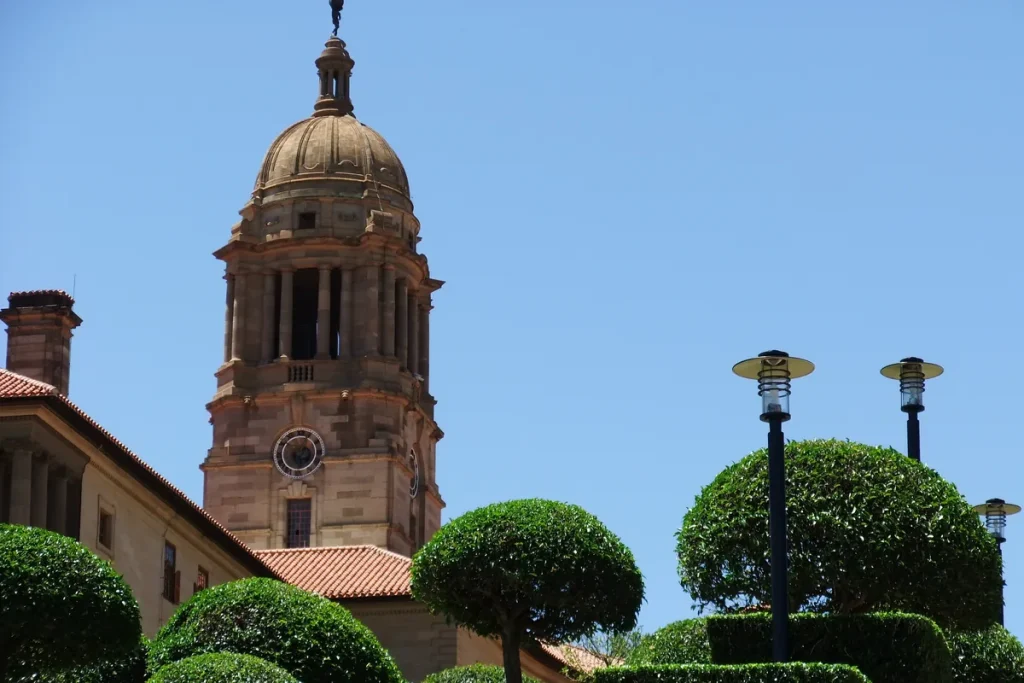
Photo: Portiatn, CC BY-SA 3.0, via Wikimedia Commons.
One of the domed towers of the Union Buildings in Pretoria, seat of South Africa’s national government, in November 2011.