
The world’s timekeepers are meeting in France this week, and ABC News reports they are expected to vote on abandoning the leap second. The leading proposal would replace it with a leap hour, which ABC says may not be needed for more than a millennium.
The 28th meeting of the General Conference on Weights and Measures, known as the CGPM, runs from Tuesday 13 to Thursday 15 October 2026 at the Palais des Congrès de Versailles, according to the International Bureau of Weights and Measures (BIPM). A pre-meeting is being held at BIPM headquarters on Monday 12 October, the bureau says.
Why Leap Seconds Exist
Atomic clocks keep very steady time, but the Earth does not turn at a fixed rate. Leap seconds were introduced to keep Coordinated Universal Time, or UTC, in step with the planet’s rotation. Since they began in 1972, leap seconds have been added 27 times, most recently at the end of 2016, according to ABC News.
Many things change the speed of the Earth’s spin, from the air above it to the mass deep inside it. Lucia McCallum, a geodesist at the University of Tasmania, gave a list: “Atmosphere, wind, big ocean currents, glaciers melting, big volcanoes, redistribution of mass in the inner Earth,” she said, according to ABC News.
The Earth has sped up since about 2020, ABC reported. That raises the prospect of a first “negative” leap second, which would take a second away rather than add one.
Why They Break Software
Leap seconds have crashed platforms including Cloudflare and Reddit, according to ABC News. They are also scheduled only six months ahead, ABC reported.
Michael Wouters, leader of time standards at the National Measurement Institute, said people “forgot about this problem, and they wrote software that then crashed when time went backwards”, according to ABC News.
A negative leap second would bring a problem of its own. “It’s never happened before, and therefore the software for that has never been tested,” said Darryl Veitch, a networking researcher at the University of Technology Sydney, according to ABC News.
Satellite navigation has its own demands. GPS needs fractions of milliseconds, which the traditional definition of a second cannot give, ABC reported.
The Road to This Week’s Vote
The decision to move away from the leap second is not new. In 2022 the BIPM’s governing body decided to abandon the leap second by 2035, according to ABC News.
In July, the BIPM’s Patrizia Tavella put the risk of a negative leap second before 2035 at 30 per cent, Scientific American reported. “We estimated that if we wait till 2035, we have 30 percent risk of a negative leap second,” she said, as quoted by Scientific American.
The leading proposal would let UTC drift until it is an hour out of step with the Earth’s rotation. A leap hour would then be added. ABC says that point could be more than a millennium away. Under that approach, the one-second adjustments that have crashed software in the past would stop, and a single larger correction would take their place at some distant date.
What Changes If the Vote Passes
The vote has not yet taken place. If the conference backs the proposal, clocks would stop being adjusted by a single second at short notice. The gap between atomic time and the Earth’s rotation would instead be allowed to build up slowly.
Dr Wouters also spoke about clocks more broadly. “But clocks themselves are a very artificial thing,” he said, according to ABC News.
There would be a smaller change for his own organisation. Speaking about National Measurement Institute staff no longer having to work on New Year’s Day, Dr Wouters said: “I’m not too unhappy that that won’t be necessary anymore,” according to ABC News.
More reporting on computing and the internet is in our Technology news section.
Sources: ABC News, “World’s timekeepers to vote on ditching leap second”, 12 October 2026 (https://www.abc.net.au/news/science/2026-10-12/we-may-be-about-to-lose-the-leap-second-for-good/107207528); BIPM, “28th meeting of the CGPM (2026)” (https://www.bipm.org/en/cgpm-2026); Scientific American, “Exclusive: International timekeepers to vote on changing the leap second to a leap hour”, 8 July 2026 (https://www.scientificamerican.com/article/international-timekeepers-to-vote-on-changing-the-leap-second-to-a-leap-hour/)
Photo: US National Bureau of Standards (now NIST), public domain, via Wikimedia Commons.
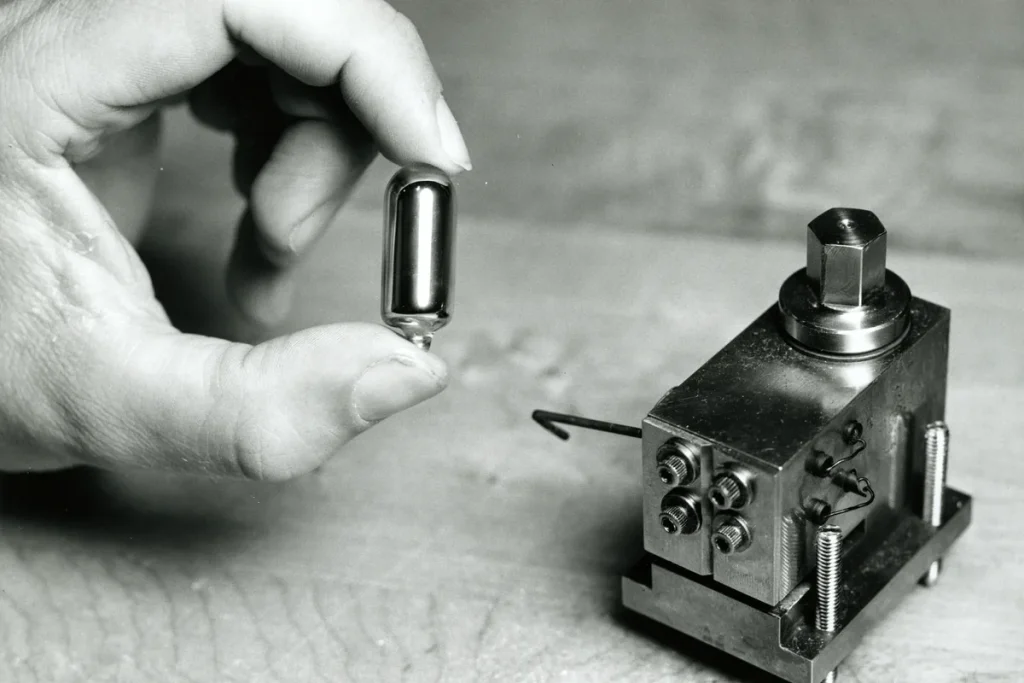
A caesium capsule, the core of an early atomic clock, held beside part of the apparatus in a photograph from the US National Bureau of Standards.