The 2026 Nobel Prize in Physiology or Medicine has been awarded to Karl Deisseroth, Peter Hegemann and Georg Nagel for discoveries that let scientists switch nerve cells on with light. The Nobel Assembly at Karolinska Institutet announced the prize in Stockholm on Monday 5 October.
Deisseroth is with the Howard Hughes Medical Institute and Stanford University, Hegemann with Humboldt University of Berlin and Nagel with the University of Wurzburg. The three were honoured “for their discoveries concerning light-gated ion channels and optogenetics”, according to the Nobel press release, and will share prize money of 12 million Swedish kronor, BBC News and ABC News reported.
The laureates said it was “absolutely wonderful” to receive the award, the BBC reported. Per Svenningsson, chair of the Nobel Committee for Physiology or Medicine, said in the press release: “Optogenetics provides opportunities for mapping the brain in a way that we could once only dream of”.
Hegemann and Nagel did the early work on a protein from an alga, and Deisseroth turned that protein into a tool for studying the brain.
Ion channels sit at the centre of the work. An ion channel is a pore in a cell’s outer membrane that lets electrically charged particles pass in and out, and the movement of those particles is how nerve cells send signals. A light-gated channel is one that opens when light falls on it.
The channel itself came from a microscopic alga. Hegemann wanted to know how Chlamydomonas, a single-celled organism, swims towards light. In the early 2000s he and Nagel discovered channelrhodopsin, a protein that opens a channel when lit by blue light and creates an electrical impulse, according to the press release, the BBC and the ABC.
Deisseroth then took the protein into the nervous system. He put the gene for channelrhodopsin into rat nerve cells and triggered a nerve signal with blue light, publishing the breakthrough in 2005, the press release said. Two years later he made it work in the brains of living mice. Working in living animals meant researchers could look at how switching a circuit changed behaviour.
That method is optogenetics. “Using light, researchers are now able to switch individual neural circuits on or off in the brain,” the Nobel Committee said, according to the BBC. Experiments using the technique have revealed circuits behind memories, feelings and behaviours that are relevant to neurological and psychiatric disorders, the press release and the BBC said.
“Optogenetics has fundamentally altered our understanding of the brain,” the Nobel Assembly said, as reported by the BBC.
Research on people, such as a study that linked technology use to lower dementia risk, can show how habits and brain health move together. Optogenetics works at a different level, letting scientists in the laboratory test what a single circuit does by switching it on or off.
From Algae to the Clinic
Among the first steps towards treatment is work on the eye. In clinical trials, researchers are working to restore some vision in people blinded by retinitis pigmentosa, the BBC reported. The Nobel press release refers to attempts in clinical trials to restore sight.
Retinitis pigmentosa is an inherited eye condition in which the light-sensing cells of the retina gradually break down, leading to a loss of sight over time. Those trials bring optogenetics out of animal research and into people.
Karolinska Institutet, a medical university in Stockholm, chooses the medicine laureates through its Nobel Assembly. The physics prize is announced on Tuesday 6 October, followed by chemistry, literature and peace, with the economics prize to come on 12 October, according to the ABC.
Sources: The Nobel Prize, “Press release: Nobel Prize in Physiology or Medicine 2026”, 5 October 2026 (https://www.nobelprize.org/prizes/medicine/2026/press-release/); BBC News, “Nobel Prize awarded for revealing inner workings of the brain”, 5 October 2026 (https://www.bbc.co.uk/news/articles/c5ev3ypmzly8o); ABC News, “Nobel medicine prize awarded to scientists for brain activity research”, 5 October 2026 (https://www.abc.net.au/news/2026-10-05/nobel-medicine-prize-2026-brain-activity-research/107231100)
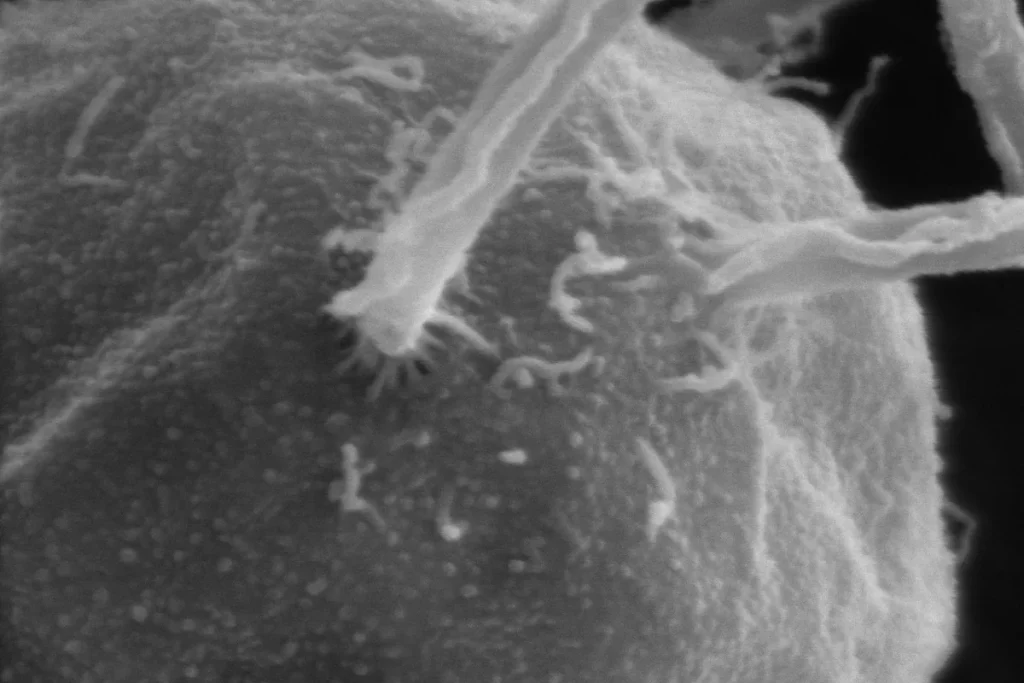
Image: Dartmouth Electron Microscope Facility, public domain, via Wikimedia Commons.
A scanning electron microscope image of Chlamydomonas reinhardtii, the single-celled alga in which channelrhodopsin was discovered. The image is not from the laureates’ research.