
Transvaginal ultrasound is now the first-line investigation for suspected endometriosis under a new national guideline, replacing an approach in which people needed surgery before the condition could be confirmed. The Royal Australian and New Zealand College of Obstetricians and Gynaecologists (RANZCOG) published the Australian Living Evidence Guideline: Endometriosis on Saturday 10 May 2025. The document is intended to guide how clinicians investigate and manage the condition.
What Changed
The guideline recommends a transvaginal ultrasound as the first-line investigation for people with symptoms. First-line describes the test offered ahead of others in the diagnostic process. A transvaginal ultrasound is a scan taken from inside the vagina. An MRI, or magnetic resonance imaging, produces detailed pictures of the pelvic organs. Where a transvaginal ultrasound is not appropriate, including because of a person’s age or sexual history, the guideline recommends a pelvic MRI instead, and it keeps a transabdominal ultrasound as an option where MRI is not available. Surgery is no longer required for a diagnosis.
The document replaces the 2021 guideline and is described as a living guideline. A living guideline is kept under regular review by its developers, with recommendations updated as new evidence appears rather than waiting for a full revision of the document. RANZCOG is the professional college for obstetricians and gynaecologists in Australia and New Zealand. Development was led by Professor Cindy Farquhar, RANZCOG’s Dean of Research and Policy, and the guideline is endorsed by the Royal Australian College of General Practitioners. It contains nine strong recommendations, 29 conditional recommendations and 40 good practice statements.
Why It Matters
Endometriosis is a condition in which tissue similar to the lining of the uterus grows outside it, and it affects people with a uterus, including women and some men. About one in seven Australians assigned female at birth are affected by the age of 44 to 49, and about 190 million people worldwide have the condition, according to RANZCOG. Symptoms include severe period pain, pain with sex, heavy bleeding and infertility.
Diagnosis has historically required surgery, and waits for that surgery have been long. The condition is estimated to cost the Australian economy $9.6 billion a year, or about $30,000 per person with endometriosis. The guideline states a small increase in ovarian and endometrial cancer with low absolute risk, and a reduced risk of cervical cancer.
Treatment Without Waiting
The guideline supports starting first-line hormonal treatment while investigations are under way, including combined oral contraceptives and progestogens, and it now includes physiotherapy and psychological support as considerations for pelvic pain. It says treatment should not be delayed while investigations are arranged. For people with symptoms, the change means a diagnosis no longer depends on surgery, and treatment can begin while imaging is arranged.
Dr Marilla Druitt, a guideline developer, said the aim was starting “with treatment and diagnosis in a parallel fashion, so there is absolutely no reason to delay treatment, which is the problem”. She said ultrasound also has limitations for superficial disease, which can be missed when a scan appears normal.
The Medicare Change
A new endometriosis-specific Medicare item will become available from November 2025, covering assessment for endometriosis tissue outside the uterus. A Medicare item sets out a service that can attract a rebate under the scheme.
Dr Druitt said: “That Medicare item number will hopefully drive more thorough looking and more thorough assessment”. She said more sonographers would need accreditation before patients could access the item.
Reaction, Including the Criticism
The guideline is accompanied by a quick reference guide and a flowchart for primary care. Professor Danielle Mazza, of Monash University, who sat on the guideline development group, said: “Having clear, evidence-based tools like the quick reference guide and flowchart will be a game-changer for primary care”.
Patient organisations responded with a mix of support and criticism, and their statements focused on how the guideline was developed and what it does not say. Jess Taylor, chair of the Australian Coalition for Endometriosis (ACE), welcomed the move to living guidelines but said it was disappointing that RANZCOG did not allow open public consultation. RANZCOG said it ran a three-week sector consultation and is now working with ACE on future updates.
Syl and Lesley Freedman, co-founders of EndoActive, said: “We are pleased to see clear recognition that hysterectomy is not a cure for endometriosis or adenomyosis. However, we are disappointed that the 2025 Guidelines still fail to state that pregnancy is not a cure or treatment for endo.” RANZCOG has called for funding beyond 2025 to keep the guideline updated, saying continued support is needed for that work.
Related: Queensland Warns of Melioidosis Risk After Cyclone Narelle Floods
Sources: The Guardian, https://www.theguardian.com/australia-news/2025/may/10/ultrasound-diagnosis-could-lead-to-faster-treatment-of-endometriosis; RANZCOG, https://ranzcog.edu.au/resources/endometriosis-clinical-practice-guideline/; Medical Republic, https://www.medicalrepublic.com.au/endometriosis-diagnosis-just-became-easier
Photo: Shixart1985, CC BY 2.0, via Wikimedia Commons.
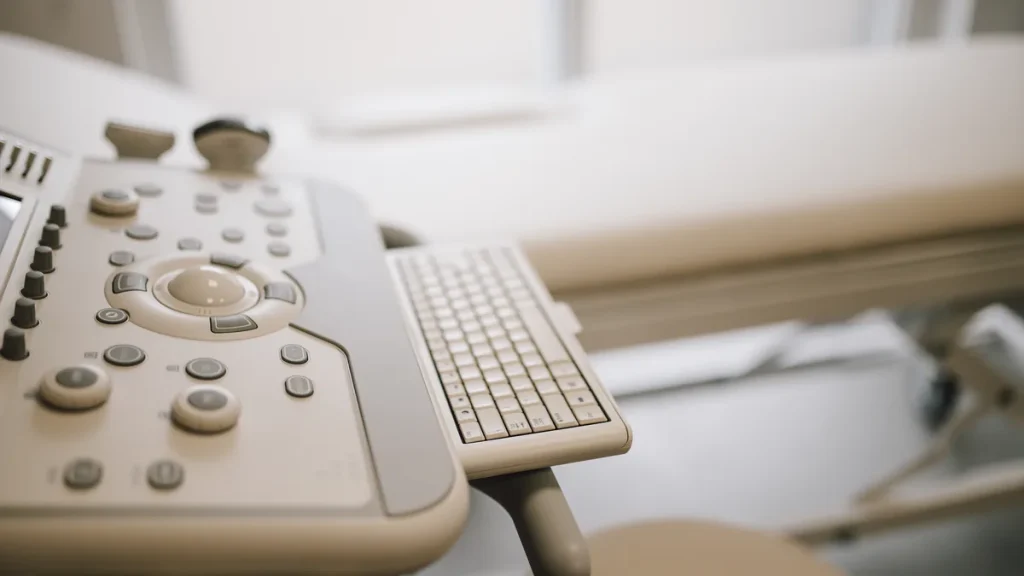
Illustrative: an ultrasound console in a medical examination room. The photograph does not show any clinic, procedure or person described in the article.