Donald Trump has denied limiting Ukraine’s access to Starshield, the military sister network of Starlink, after speeds were cut this week. Speaking to reporters as he left the White House on Friday, he said he was “not sure” it “ever came down”, BBC News reported. “It wasn’t me and I don’t think it was [Starlink owner] Elon [Musk],” Mr Trump said.
Ukraine’s President Volodymyr Zelensky says access is not fully restored. After meeting EU leaders, he said, according to the Guardian: “Have they returned to the previous speed limits? No. But is it coming back now? Yes.”
What Changed on Tuesday
Starshield, the military-grade sister service designed for the Pentagon, relies on Starlink, a civilian network operated by Elon Musk’s SpaceX, the BBC reported. The US government has allowed Ukraine to use both in its defence against Russia. Mr Musk cut Moscow’s access to the service in February.
The US had warned it could withhold intelligence if Ukraine kept hitting Russian refineries, the BBC reported. Mr Zelensky resumed the strikes this week after Russia continued attacks during an “energy ceasefire” Mr Trump announced on Sunday. Mr Trump told Newsmax the renewed strikes were “a disgrace”, according to the Guardian.
On Tuesday night Starlink restricted speed limits to 100mph (160km/h), so weapons travelling faster lost connectivity, the BBC reported. Ukraine was hit by several deadly strikes on Tuesday after the slowdown, and some 600,000 people were left without power. Mr Zelensky called the reduced speeds a “very dangerous and unpleasant surprise”, the Guardian reported.
Competing Accounts of the Order
Mr Musk earlier said Starshield was managed by the US government and the Pentagon could have been responsible, the BBC reported. On Wednesday he wrote on X: “Starshield systems are owned and controlled by the US government. Any limits on speed or usage are decided by the US military and ultimately [the US president]”.
Reuters, as reported by the Guardian, said the order to throttle Starshield came from inside the White House, according to two US officials and a western official, who did not identify the White House official. A US official told the BBC “no such request was ever made by the president [Donald Trump]”.
“Our defence ministry is in touch and my partners, they told me that there were signals from the White House that they would return these capabilities,” Mr Zelensky said, according to the Guardian.
Mr Trump had said Mr Zelensky was “more difficult to deal with than [Russian President Vladimir] Putin”, but on Friday he said he had a good relationship with him, the BBC reported.
Senators Want an Investigation
A bipartisan group of US senators has asked the defence department inspector general to investigate whether the restrictions were caused by the department or its contractors, the BBC reported. Democrat Jeanne Shaheen led the letter, and its signatories include Republicans Thom Tillis, Susan Collins, Lisa Murkowski and John Cornyn.
The letter says the “restrictions reportedly degraded Ukraine’s ability to conduct defensive operations against Russian drone and missile attacks on civilian infrastructure”. The senators also said they were “deeply concerned” by reported disruptions affecting intelligence-sharing and threat-warning capabilities, and “particularly alarmed” by incidents in which US personnel could not reach designated bunkers during Russian air raids, the BBC reported.
Europe Steps Up as Washington Wavers
Mr Zelensky told the European Council the war would cost €155bn in 2027 and asked the EU for at least €70bn more, the Guardian reported. Ursula von der Leyen agreed there was “a gap of €70bn that has to be covered”.
The bloc’s 27 leaders applauded Mr Zelensky, who said he had heard “only support”. The EU is paying Ukraine from a €90bn plan agreed last December, and Russia’s €210bn of assets frozen in the EU are back under discussion, with Belgium strongly opposed to using them, according to the Guardian. Ms von der Leyen promised a 22nd round of sanctions and said: “We will not lift any sanctions unless Russia stops the war.”
At the end of the two-day Brussels summit, French President Emmanuel Macron vowed that EU states would not abandon Ukraine, and said it was Europe’s job to hold the line in the face of some people’s “ambiguities”, the BBC reported.
Related reports are in our Defence & Security section.
Sources: BBC News, “Trump denies limiting Ukraine access to Starlink network”, 16 October 2026 (https://www.bbc.co.uk/news/articles/ckz65g34wyd8o); The Guardian, “Starlink access still not fully restored for Ukraine’s military, says Zelenskyy”, 16 October 2026 (https://www.theguardian.com/world/2026/oct/16/ukraine-military-starlink-access-starshield-volodymyr-zelenskyy); BBC News, “US senators call for investigation into Ukraine Starlink restrictions”, 16 October 2026 (https://www.bbc.co.uk/news/articles/cq398zl8jmvdo)
Photo: Ka23 13, CC BY 4.0, via Wikimedia Commons.
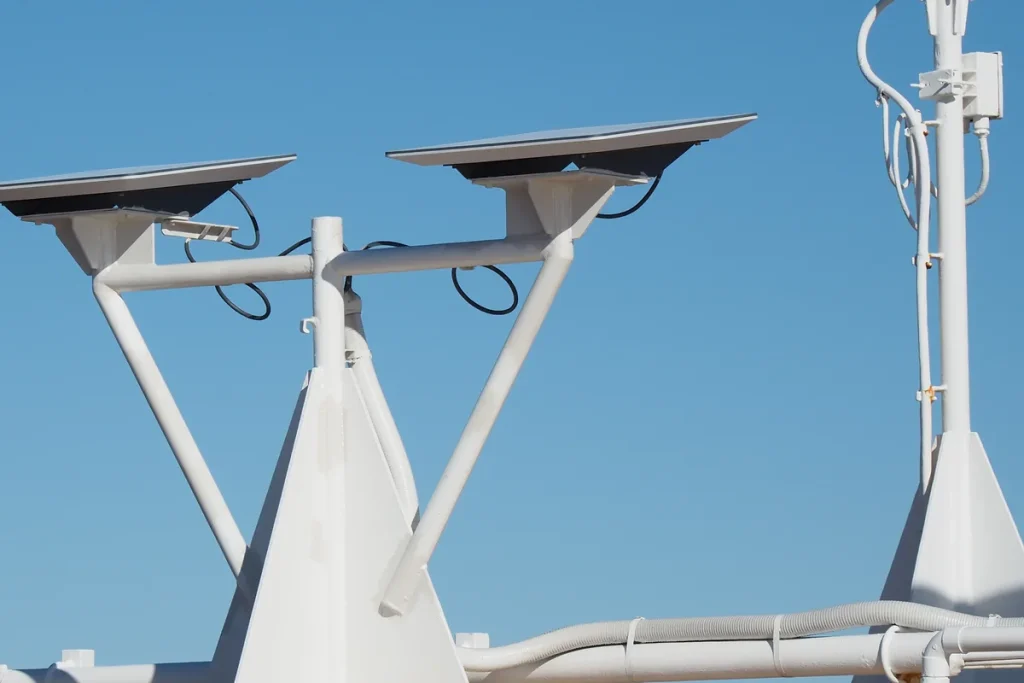
Two Starlink flat-panel terminals mounted on a ship’s mast in January 2025: a civilian set-up, not military equipment in Ukraine.