The AFL has capped the amount of contact training its clubs can do during the pre-season, in the biggest change yet to how the league manages concussion.
The limits, announced on 7 September 2026, hold clubs to 120 minutes of contact work a week in the first month of the pre-season, with 60 minutes of that permitted at high intensity.
From week five, the ceiling rises to 160 minutes of contact work a week, with 120 minutes of it at high intensity. AFL.com.au and SEN reported the details on the day of the announcement.
Contact training covers the drills in which players tackle, bump and absorb physical contact, and the league’s answer to concussion now runs through that part of the week, where the volume of contact can be counted and controlled in a way that match play cannot.
The rules apply to the men’s pre-season, and they set the terms for how clubs prepare from the first week through to the start of the season. For clubs, the caps change the balance of the pre-season week, which now has to be built around a contact allowance that is fixed in advance.
The Guardrails Around the Limits
The limits come with conditions that bind clubs to them. No high-intensity contact sessions can be scheduled on back-to-back days, which forces a gap between the heaviest blocks of contact work.
Club loads will be subject to audits, and training vision must be provided to the AFL on request, so the league can review what a session contained rather than relying on a club’s own records alone.
The league will also carry out spot audits to test whether clubs are complying with the limits. The conditions run alongside the minute limits and cover the pre-season as a whole.
The Coroner’s Findings Behind the Change
The changes arrive against the backdrop of the 2023 findings of the Victorian coroner after the death of Shane Tuck, a former player who was diagnosed with Stage 3 chronic traumatic encephalopathy.
Chronic traumatic encephalopathy is a degenerative brain disease associated with repeated impacts to the head, and the Tuck case placed the long-term consequences of those impacts at the centre of the debate over the sport’s safety. Because the disease can be diagnosed only after death, cases such as Tuck’s carry particular weight in the argument over how much head contact the game should allow.
Since then, the league has been under continuing pressure to reduce the number of head impacts players absorb across their careers, and the pre-season limits are its most direct response yet.
The Incident That Forced the Issue
In May 2025, Lachie Schultz was concussed at Optus Stadium and play ran on for about a minute.
The delay drew criticism at a time when the treatment of head injuries was already under scrutiny, and it raised questions about how quickly the game stops when a player has taken a hit to the head. Those questions sit at the centre of the new rules, which are designed to lower the amount of contact players absorb before the season starts.
The fallout from the incident became as consequential for the league as the concussion itself. That episode sits directly behind the training rules announced in September.
The Part the AFL Got Wrong
In the aftermath, information that circulated about the incident falsely implicated the field umpires.
The league later said the misinformation had come from its umpiring department, not from the officials who controlled the match, and that its own process had failed.
The AFL apologised to the umpires, who had been wrongly accused, and it placed the failure inside its own systems rather than with the officials on the ground. The correction became part of the public record of the incident.
What Is Still Missing
The framework does not cover everything.
There are no in-season limits on contact training yet, so the caps govern the pre-season and fall away once the home and away season begins.
An AFLW framework is still to come, which leaves the women’s competition without an equivalent set of rules in place.
Community football has not been brought under the mandate, so the limits do not extend to the local and suburban competitions where most of the game is played.
Headgear has not been proven to reduce concussion, which means the league’s approach rests on managing how much contact players absorb rather than on equipment.
Each of those areas sits outside the framework the league has announced, so the changes settle the pre-season only while the wider questions remain open. For now, the caps change how clubs prepare rather than how the game itself is played.
Related: King Charles III Named Among Guests for Historic MCG Test Cricket Celebration
Sources: AFL.com.au, https://www.afl.com.au/news/1606530/; SEN, https://sen.com.au/news/2026/09/07/afl-news-afl-reveals-details-of-contact-training-limits; AAP via The Examiner, https://www.examiner.com.au/story/9345319/afl-introduce-training-limits-over-concussion-concerns/
Photo: Alexander Sheko, CC BY-SA 2.0, via Wikimedia Commons.
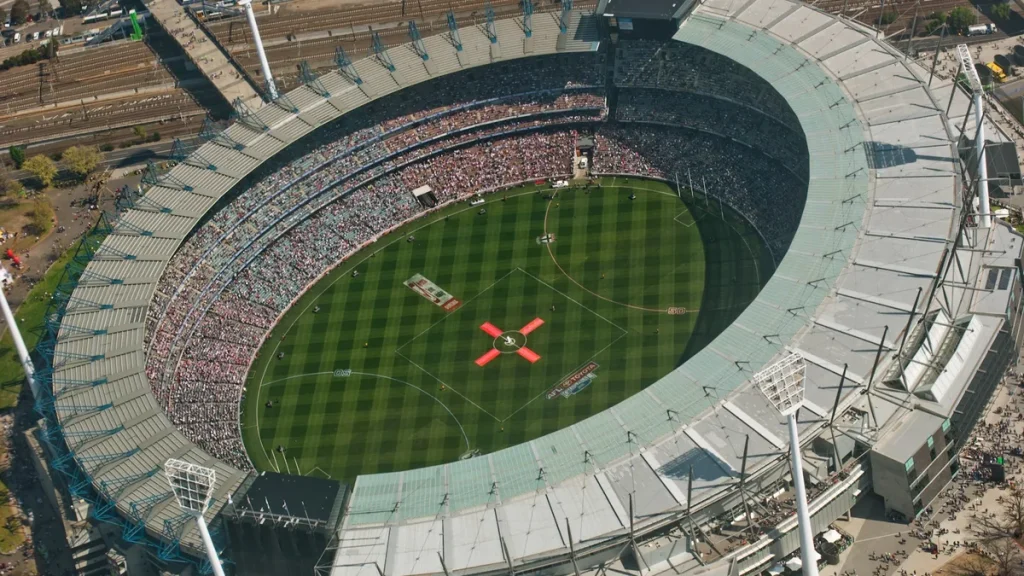
Illustrative – the Melbourne Cricket Ground during an AFL Grand Final. This photograph is not from the announcement described in the article.