
Australia Asked to Help Middle East Nations Facing Iranian Attacks — What Could Its Role Be in the Escalating Conflict?

- Australia has been asked by Middle Eastern nations for military assistance after Iran launched missile and drone attacks on several countries in the region.
Australia is considering how it may assist Middle Eastern nations that have faced missile and drone attacks linked to Iran, as regional tensions intensify and governments across the Gulf seek additional defensive support. The request for assistance has been confirmed by Australia’s foreign minister, Penny Wong, who said the government is carefully assessing how it could respond while avoiding direct involvement in combat operations.
Speaking about the situation, Wong said several countries that are not directly involved in the conflict have been struck by Iranian attacks. Because of this, those nations have reached out to partners such as Australia for help.
She said the Australian government would examine the request cautiously before making any commitments, emphasising that decisions would be guided by national interest and international responsibilities.
The issue has already reached the highest levels of government. Australia’s national security committee of cabinet met on Monday to review the situation and is expected to continue discussions in further meetings. The committee typically handles matters involving defence strategy, military deployment and international security crises.
Possible military contributions from Australia
Defence analysts say Australia’s potential contribution would most likely involve defensive capabilities designed to detect and respond to missile or drone threats. The conflict has seen increasing use of unmanned aerial vehicles and missile systems targeting infrastructure across the Middle East, including oil facilities and military sites.
Unlike the United States and some NATO partners, Australia does not operate advanced missile defence systems such as the Patriot battery. However, the Australian Defence Force has begun introducing the National Advanced Surface-to-Air Missile System, known as NASAMS, which is designed to counter short- to medium-range aerial threats.
Despite this, experts suggest Australia’s most valuable contribution may come from surveillance and intelligence systems rather than missile defence.
Fergus McLachlan, a retired Australian Army major general who previously served in Afghanistan and Iraq and now works as a defence industry adviser, said the most practical role for Australia would involve its airborne early warning aircraft.
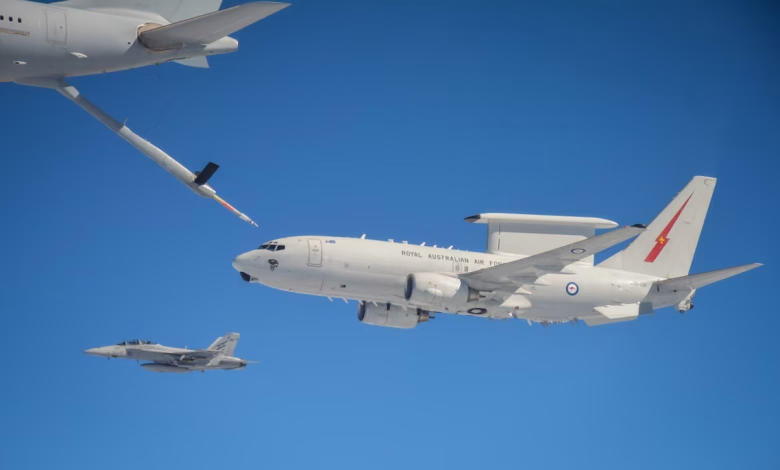
Australia operates six E-7A Wedgetail aircraft through the Royal Australian Air Force. These aircraft function as airborne command and surveillance platforms capable of tracking aircraft, missiles and drones over large areas.
McLachlan said the Wedgetail system is widely regarded as one of the most advanced in the world. He pointed out that similar deployments have already taken place in Europe, where the aircraft has operated from Poland to monitor aerial activity near Ukraine.
Using powerful radar systems and communication technology, the aircraft can detect incoming threats and pass information to interceptor aircraft or ground-based defence systems.
In a conflict environment, such information could help allied forces identify and destroy drones such as Iran’s Shahed series before they reach their targets.
However, analysts note that deploying these aircraft in the Gulf would create political and operational complications.
A key concern is that Australian crews operating surveillance aircraft would inevitably observe offensive military operations carried out by the United States or Israel against Iranian targets. The Australian government would therefore need to ensure that any mission strictly supports defensive activities rather than offensive operations.
Other possible aircraft involvement
Australia’s air force also operates several advanced combat aircraft that could theoretically play a role in countering drones or missiles.
These include the EA-18G Growler electronic warfare aircraft, the F/A-18F Super Hornet and the F-35A Joint Strike Fighter.
Each of these aircraft is capable of detecting and engaging airborne threats or disrupting enemy radar and communications systems.
However, the government has not indicated that these platforms are being considered for deployment at this stage.
Instead, officials have stressed that Australia will not participate directly in ground combat or offensive operations.
Wong made this point clearly when speaking publicly about the crisis. She said Australia would not send troops to fight in a ground war in the Middle East.
According to the foreign minister, the government has set clear limits on its involvement, emphasising that the situation is different from previous conflicts such as the Iraq war.
Domestic political debate
Australia’s possible role in the conflict has sparked debate across the political spectrum.
Opposition figures have called for further briefings on the government’s plans. Shadow defence minister James Paterson has requested detailed information about any proposed assistance.
At the same time, some political groups have warned against Australia becoming drawn into another prolonged military conflict.
The Greens have criticised the government’s language around assistance, arguing that it risks creating what they describe as “mission creep”. Their foreign affairs spokesperson, David Shoebridge, has urged the government to avoid deeper military involvement.
The party has also called for assurances that intelligence facilities in Australia, including the joint United States-Australian Pine Gap facility in the Northern Territory, will not be used to support the war.
Outside parliament, several international law experts and former diplomats have raised concerns about the broader conflict involving Iran. They argue that military action against Iran could violate international law and potentially trigger wider regional escalation.
Some activists within the Labor Party have also voiced criticism. The group Labor Against War has publicly condemned the bombing campaign against Iran and called on the government to withdraw support from military operations in the region. The group has also urged Australia to reconsider its involvement in the Aukus nuclear submarine agreement.
Former prime minister Tony Abbott has taken the opposite position. Writing about the conflict, he criticised the current government for not doing enough to support the United States and its allies.
Abbott argued that preventing Iran from expanding its nuclear programme would improve global security and said Australia should take a more active role in supporting allied efforts.
Australia’s current actions in the region
While decisions about military assistance are still being considered, Australia has already taken steps to assist its citizens in the region.
The Australian Defence Force has launched Operation Beech, which focuses on consular support and evacuation planning for Australians stranded in parts of the Middle East.
As part of this effort, the Royal Australian Air Force has deployed a C-17A Globemaster heavy transport aircraft along with a KC-30A Multi-Role Tanker Transport aircraft.
These aircraft can be used to evacuate Australians or provide logistical support if the situation deteriorates further.
The government has also advised Australians in the region to leave using commercial flights where possible.
Because of airspace restrictions in Qatar, some Australians have been transported by bus to Saudi Arabia in order to catch flights out of the region.
In a separate development, Prime Minister Anthony Albanese confirmed that three Australian sailors were aboard a United States submarine that sank an Iranian warship near Sri Lanka. The incident reportedly resulted in the deaths of at least 87 people.
The revelation has further highlighted the extent to which Australian personnel may be indirectly involved in operations alongside allied forces.
Operational assets potentially relevant to Middle East defence
Asset or System
Country Operating It
Primary Role
Possible Use in Conflict
E-7A Wedgetail
Australia
Airborne early warning and control
Detect drones and missiles, coordinate interceptions
NASAMS air defence system
Australia (being introduced)
Short to medium range missile defence
Protect infrastructure and military bases
F-35A Joint Strike Fighter
Australia
Multirole stealth combat aircraft
Intercept aerial threats
EA-18G Growler
Australia
Electronic warfare aircraft
Disrupt enemy radar and communications
C-17A Globemaster
Australia
Strategic airlift aircraft
Evacuation and logistics support
KC-30A Tanker Transport
Australia
Aerial refuelling and transport
Support long-range air missions
As tensions across the Middle East continue to evolve, Australia’s response will likely remain cautious and limited. Officials appear determined to balance support for international partners with a clear effort to avoid becoming directly involved in another prolonged conflict.