The Australian Pavilion at the Venice Architecture Biennale has opened with ‘Home’, a rammed earth and plaster installation designed and built by The Creative Sphere, the first all-First Nations team Australia has sent to the architecture biennale.
The Pavilion
The pavilion opened at the Giardini in May 2025. The Creative Sphere is made up of seven First Nations designers, among them the creative directors Michael Mossman, Emily McDaniel and Jack Gillmer-Lilley, with Bradley Kerr, Clarence Slockee and Elle Davidson in the wider group. The structure measures 4.8 metres by 9 metres and was first prototyped at the University of Sydney before being rebuilt on site from materials sourced within the Veneto region, including clay, plaster and plywood. The materials were brought in by barge and moved by wheelbarrow and makeshift ramps. Its walls are made from 139 individually cast plaster panels, each requiring at least five or six people to make, and the build uses no screws, adhesives or metal fixings. The installation will be dismantled and its materials returned to the landscape when the biennale closes.
What the Team Says
Jack Gillmer-Lilley, who is Worimi and Biripi Guri, said: “The oils of our skins are embedded throughout this entire exhibition.” On the meaning of home, he said: “For me, the definition keeps changing, it’s not tangible. I never had a stable home growing up… Home for me is where I can feel connected with my family, regardless of where in the world I am at the time.”
On home, Bradley Kerr, who is Quandamooka, said: “We didn’t want to impose a feeling or an image or an idea on to people. We wanted people to find something they relate to and connect to.” He said home used to be “where Mum is” and is now wherever he can “share in his son’s smile and stupid fart jokes”.
On the Voice referendum defeat and Creative Australia’s subsequent cancellation of the 2026 art biennale commission, Kerr said: “We’re still trying to demonstrate that we want to move forward together, and that we want to celebrate and share our culture with Australian people. We want to continue to be generous, in spite of all the backlash, the racism that we have to manage and juggle and face on a daily and weekly basis.” He added: “People want, and expect, marginalised people to feel all of that deep sadness and trauma. But our strength comes from joy, in spite of all of the challenges that we face. Joy in itself can be an act of resistance.”
Emily McDaniel said: “HOME is a generous and timely offering to the Venice Architecture Biennale that will welcome visitors as active contributors and participants.”
The Context
Creative Australia cancelled its commission of artist Khaled Sabsabi and curator Michael Dagostino for the 2026 art biennale. The team responded with a statement: “As First Nations people, we respond to this act of censorship, exclusion and marginalisation with disappointment and concern.” The pavilion was developed amid the fallout from that decision, and although it was not conceived as a response to the Voice referendum defeat, it became one for the team. The Guardian reported that only 0.3 per cent of architecture students graduating from Australian universities identify as First Nations, and noted recent First Nations design recognition including the Darlington Public School by FJC Studio and the Yellamundie library, named one of the world’s four most beautiful new libraries.
The Wider Exhibition
The project also drew contributions from 125 students at 11 Australian universities, whose small “living belongings” surround the exhibition. The pavilion remains open for the run of the biennale. The commission was supported by Creative Australia with the Australian Institute of Architects.
Related: Remains of Tasmanian Aboriginal Man Returned Home After 170 Years in Scotland
Sources: The Guardian, https://www.theguardian.com/artanddesign/2025/may/10/venice-biennale-architecture-the-creative-sphere-australia-design; Indesignlive, https://www.indesignlive.com/articles/home-venice; ArchitectureAU, https://architectureau.com/articles/australias-venice-biennale-team-on-the-politics-of-words-space-and-place
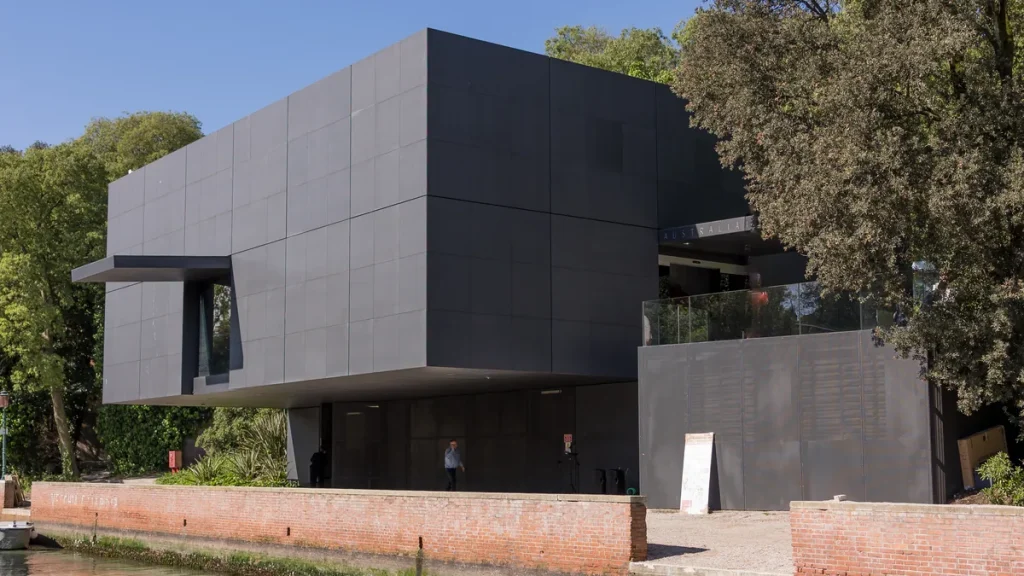
Photo: LucaFazPhoto, CC BY-SA 4.0, via Wikimedia Commons.
The Australian Pavilion in the Giardini at the Venice Biennale, photographed in April 2024. The photograph is not from the installation described in the article.