
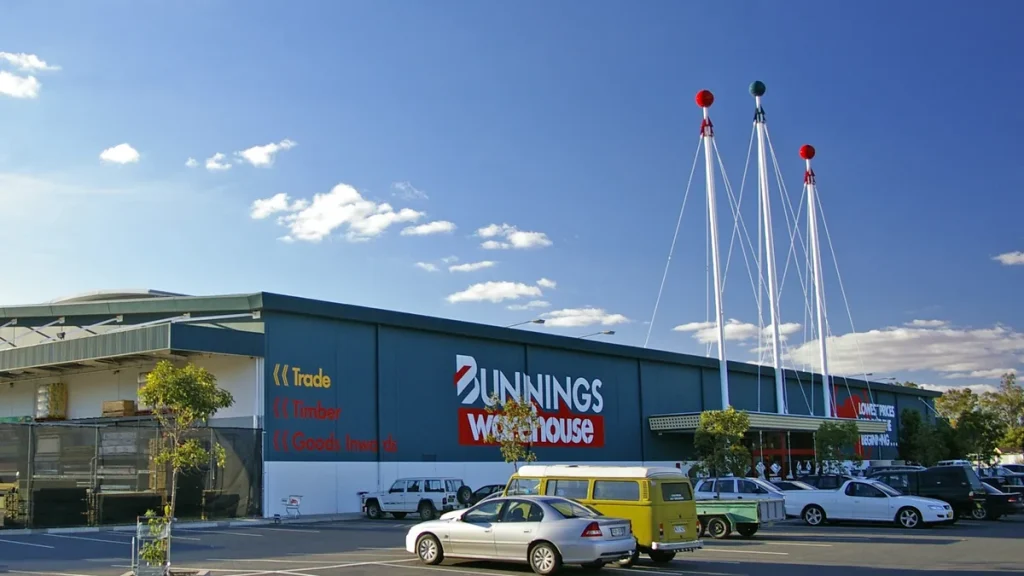
Bunnings promises shoppers that it will beat a competitor’s lower price by 10 per cent on the same stocked item. For more than 9,000 of the products it sells, that comparison cannot be made, because the products are home brands owned by Bunnings and sold by no one else.
The figure comes from the ABC’s Four Corners investigation, which reported in May 2025 that the retailer’s home-brand range had passed that mark.
The Promise and the Catch
The guarantee is built as a comparison, and the comparison has to be exact. A shopper who finds the same stocked item cheaper at another retailer can ask Bunnings to beat that price by 10 per cent: the beat comes off the competitor’s price, not Bunnings’ own price. The promise applies item for item, so it only operates where a rival stocks the identical product, and a home brand sold only through Bunnings can never meet that condition.
Home brands are products made for a retailer and sold under a name that retailer controls, so they appear on no other retailer’s shelves. That is where the promise runs out. On the brands Bunnings buys from other companies, a competitor may stock the same item and the shopper can do the comparing, but on the home brands there is no second price to match.
What the ABC’s Investigation Found
The investigation reported that more than 9,000 Bunnings lines are home brands, and named brands including Citeco, Jumbuck, Trojan, Bastion, Estilo, Craftright, Marquee and Mondella.
The brands do not carry the Bunnings name, and ownership is traceable only through the trademark register or the Wesfarmers annual report, which lists the brands held by Bunnings’ parent company. Both records are public, so the ownership of any one of the brands can be checked.
The Price Comparison
The guarantee invites a narrow comparison: one item, two retailers, two prices. On the brands Bunnings buys from other companies, the check can be made. A competitor may stock the same item, and the shopper can take the two prices to the counter. On the home brands, the search ends where it starts.
Nothing in the promise fills that gap. The 10 per cent applies to a competitor’s price, and a product sold at one retailer only has none, so the guarantee has no second figure to work from. The guarantee is a price beat rather than a low-price promise, and its value on any product depends on whether anyone else sells it.
What the ACCC Says
Home brands are lawful, and the Australian Competition and Consumer Commission does not require retailers to identify their own products as home brands. Labelling law governs what a product must say about itself, and brand ownership sits outside it. A retailer can therefore sell its own brand without telling shoppers that it owns it.
The commission’s stated concern is narrower: marketing a home brand as though it belonged to a third party may mislead shoppers. That is a question about presentation rather than ownership, and no case has been brought over the guarantee.
What Bunnings Says
In response to the investigation, Bunnings said home brands account for about 3 per cent of its nearly 300,000 products. The company said the price promise is applied with a common-sense approach to like-for-like matching, and that it complies fully with labelling law.
The two sets of figures agree on the scale of the range: 9,000 lines out of nearly 300,000 is about 3 per cent. By the company’s account, the home brands are a small share of what the retailer sells, and the promise covers the rest wherever a matching product can be found.
What It Means for Shoppers
For shoppers, the guarantee still does what it says on the brands Bunnings buys from other companies, which make up the rest of the range. Find the same stocked item cheaper at a competitor, and the promise applies.
The limit falls on the home brands. A customer who suspects a cheaper equivalent exists elsewhere has no like-for-like price to point to, and the law does not require the brand to be identified as the retailer’s own, so the ownership trail runs through the trademark register or the Wesfarmers annual report.
The ABC’s investigation reported calls for clearer labelling, so that shoppers can tell a home brand from a third-party product before they buy. Until that changes, the guarantee’s reach depends on a question the shopper has to answer first: who owns the brand.
Related: DroneShield (ASX: DRO) Shares Slide Following Director Share Sale Disclosure
Sources: ABC News, https://www.abc.net.au/news/2025-05-12/bunnings-warehouse-hardware-price-guarantee-four-corners/105274564; RNZ, https://www.rnz.co.nz/news/world/560778/bunnings-boasts-about-its-price-beating-guarantee-but-for-9000-products-in-australia-there-is-a-catch
Photo: Bidgee, CC BY 3.0, via Wikimedia Commons.