The Great Aussie Pay-Off: Cash Loyalty vs Tap-and-Go Life
In a nation where you can tap to buy a milkshake but still need coins for a sausage sizzle, the battle between card-only and cash-preferred businesses is heating up — and no one wants to be caught short at the till.
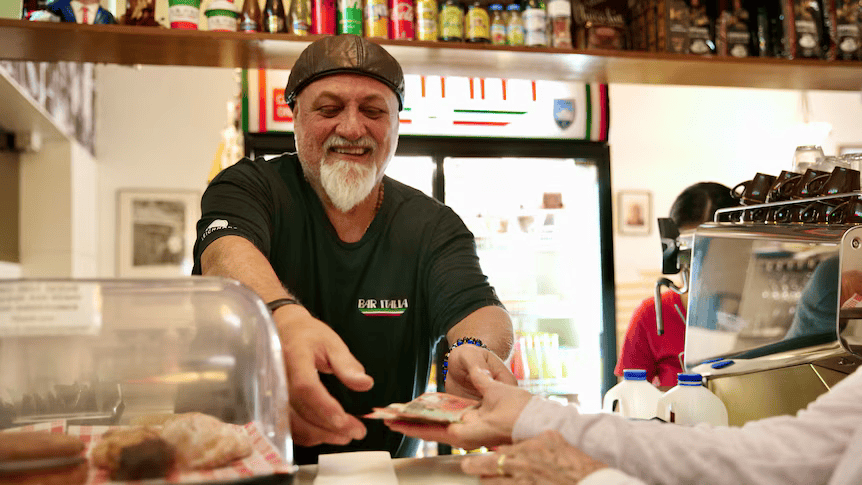
Take Leichhardt icon Bar Italia, where card machines are as welcome as pineapple on pizza. “We’re just continuing a legacy,” says owner Con Damouras, whose café has run on cash since 1952.
Over in the Sydney CBD, Pablo & Rusty’s café has been card-only since 2017. For them, it’s less about rebellion and more about “efficiency, safety, and hygiene,” says co-owner Chris Tate.
So, is cash still king — or are we all just paying more for convenience?
Card vs Cash: By the Numbers
| Metric | Value or Detail |
|---|---|
| Share of cash transactions (2024 est.) | ~10% (Macquarie University) |
| Estimated annual surcharges (Australia) | $1 billion (Reserve Bank of Australia) |
| Monthly household spending (avg.) | $3,000 (approx.) |
| Typical card surcharge | ~1% ($30/month per household) |
| Bar Italia surcharge for ATM withdrawal | $2.50 |
| Pablo & Rusty’s card surcharge for dine-in | Small fee via ordering app |
| Government cash mandate | Essential businesses must accept by 2026 |
Two Cafes, Two Very Different Bills
- Bar Italia (Cash-Only)
- Legacy Italian café in Sydney’s inner west
- Cash preferred since 1952
- No soy milk, no credit cards — “Just the old-school way,” says Damouras
- Customers use the in-store ATM (for a $2.50 fee)
- “We keep prices low and dodge the bank fees,” he adds
2. Pablo & Rusty’s (Card-Only)
- CBD café, cashless since 2017
- Motivated by security, speed, and cleanliness
- “Staff aren’t stuck handling till drawers or going to the bank,” says Tate
- One-off cash allowed for unprepared customers
- Table ordering app comes with a small service fee
Expert View: Is Tap & Go Just ‘Swipe and Sigh’?
Dr Lyla Zhang, associate professor of economics at Macquarie University, says cash might be fading, but it’s still vital — especially for older Aussies or rural communities.
“Cash helps people budget and avoid fees. Cards are convenient but come with hidden costs — mostly surcharges.”
She warns that those 1% fees add up:
“It might seem small — $30 a month — but that’s $360 a year just in surcharges.”
The Policy Pivot: What’s Canberra Doing?
With the rise of digital-only payments, the government announced in November that from 2026, essential businesses (think groceries, chemists) will be required to accept cash.
But no one quite knows which businesses qualify. “We don’t know if we’re considered ‘essential,’” says Tate from Pablo & Rusty’s. “If we have to start handling cash again, that’s an added cost for small cafés like ours.”
The ACCC says businesses are free to accept whatever payment methods they prefer — but they must be transparent about it upfront. No hiding the surcharge behind a barcode.
Aussie Consumer Tips: What You Can Do
✔ Always check signs at the entrance or counter
✔ Ask if there’s a surcharge for card — especially for dine-in
✔ Carry a mix of payment options
✔ Use low-fee cards or banks with surcharge rebates
✔ Be alert to apps or QR code services with hidden charges
Final Thought: A Fiver for Your Thoughts?
In a world where you can pay with your phone, watch, or even your fridge, cash might feel like it’s from another era. But as Dr Zhang says:
“There’s no one-size-fits-all. It’s not about being political — it’s about being practical.”
So whether you’re tapping for a turmeric latte or handing over a pineapple for a pub schnitty, just know this: how you pay does matter — not just to your wallet, but to how Aussie businesses thrive (or survive).